

What if a shipment of guestroom electronics arrives late, or linen quality differs from the approved standard? A hotel procurement risk mitigation plan should define who acts and what happens next before an issue affects an opening schedule or daily operations. Risk is not limited to supplier delays. Unclear ownership and escalation steps can turn a manageable problem into a disruption across departments.
Dependable supply and consistent quality matter to guest experience and operational continuity. The challenge is turning those priorities into controls teams can use. This guide offers a practical framework for identifying risks by hotel category and project stage, then assigning each one a proportionate control, accountable owner, evidence requirement, and escalation path.
You’ll also learn how to compare sourcing approaches based on the risks they address. From requirement approvals and quality checks to delivery coordination and contingency steps, the checklist connects procurement decisions with the people responsible for keeping plans on track.
Key Takeaways
- Shape a hotel procurement risk mitigation plan around property priorities, project stage, and guest-facing standards.
- Build a risk register that records each exposure, its consequence, the control, the accountable owner, and the escalation route.
- Match controls to the risks they address, and retain evidence such as approvals, inspection records, and delivery updates.
- Use stage-based checks before approval, during sourcing, before dispatch, at receipt, and after delivery to catch gaps early.
- Coordinate sourcing, quality control, and logistics through a turnkey supply approach to support consistent execution across hotel categories.
Why a Hotel Procurement Risk Mitigation Plan Starts With Property Priorities
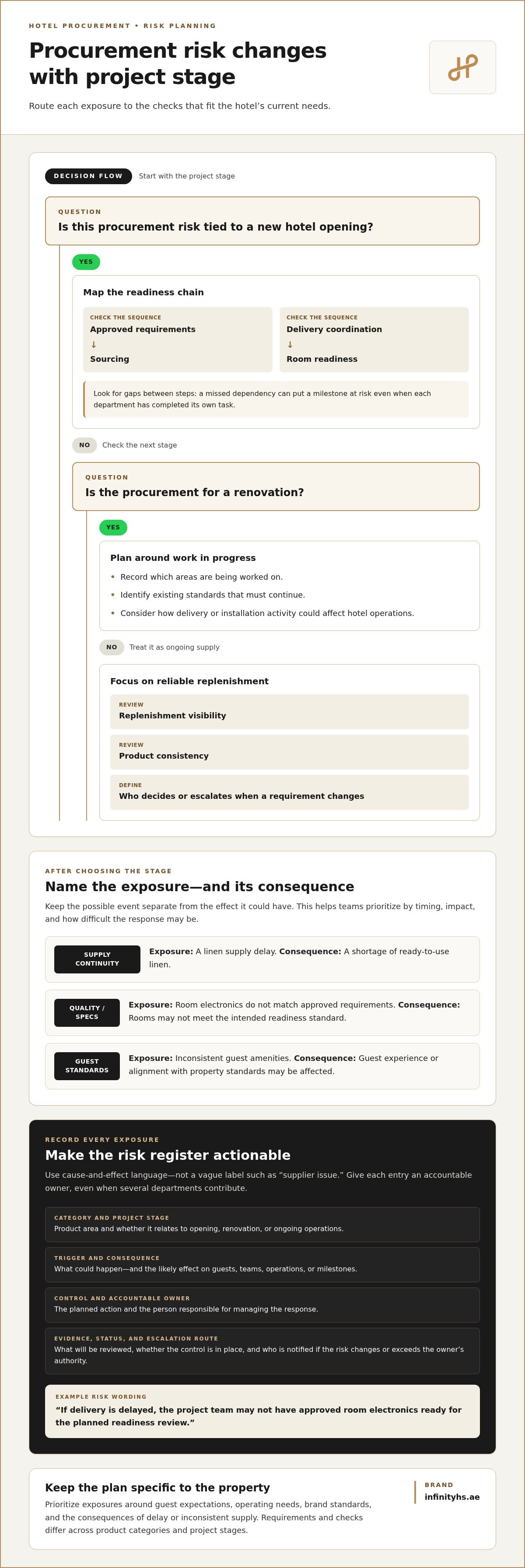
A hotel procurement risk mitigation plan works best as an active management tool, not a document that sits untouched after approval. It helps a team identify exposures, decide which deserve attention first, assign responsibility, and review whether controls remain effective. Priorities should reflect the property’s guest expectations, operating needs, brand standards, and the consequences of a delay or inconsistent supply.
Project stage matters, too. A new opening depends on approved requirements, sourcing, delivery, and readiness moving in step. Renovation procurement must account for phasing and existing standards while limiting disruption to guests and staff. For an operating hotel, the focus shifts to reliable replenishment, consistent products, and clear decisions when supply or quality issues arise.
For a brief overview of procurement risk mitigation strategies, watch this video:
A practical definition keeps the discussion precise: a risk is a possible event, its impact is the consequence if it occurs, and its control is the action that reduces its likelihood or effect. This distinction prevents teams from treating every concern as an immediate crisis. It also places hotel-specific decisions within the broader procurement process, where planning, sourcing, and supplier management all influence outcomes.
Which hotel procurement risks deserve early attention?
Group exposures so teams can compare like with like. Supply continuity concerns whether items arrive when needed. Quality risk concerns whether delivered goods meet approved expectations. Specification alignment checks that requirements are understood consistently. Planning risk arises when procurement dependencies are missed, while supplier dependence can leave limited alternatives if a source is disrupted.
- Hotel linens: A supply delay is the disruption; a shortage of ready-to-use linen is the operational consequence.
- Room electronics: A mismatch with approved requirements is the risk; rooms may not meet the intended readiness standard.
- Guest amenities: Inconsistent products can affect the guest experience and alignment with property standards.
Prioritize exposures by considering timing, guest or team impact, and how difficult each would be to respond to. A possible disruption and its consequence are related, but they are not the same register entry.
How does procurement risk vary by hotel project stage?
Use the project stage to make risk identification specific. For a new opening, map how approved requirements connect to sourcing, delivery coordination, and room readiness. A gap between these steps can put a milestone at risk even when each department has completed its own task.
For renovations, record which areas are being worked on, which existing standards must continue, and where delivery or installation activity could affect hotel operations. For ongoing supply, review replenishment visibility, product consistency, and who can make or escalate decisions when a requirement changes. The relevant checks differ, so avoid applying one generic risk list to every phase.
Start with the property’s priorities, then record each exposure and its likely consequence separately. That foundation makes the next step, assigning controls and owners, more focused and useful.
Build a Hotel Procurement Risk Register With Owners and Evidence
A risk register turns the priorities identified for a property or project into decisions people can manage. For each exposure, record what could happen, what it could affect, who owns the response, and what evidence will show whether the control is working. This makes a hotel procurement risk mitigation plan practical across procurement, operations, housekeeping, and project teams.
Organize entries by category and project stage. A linen supply concern during a renovation may have a different trigger and response from an amenity replenishment issue during normal operations. Requirements also vary across operating supplies and equipment, so define the relevant product needs and checks for each category instead of applying one generic description to everything.
What belongs in a hotel procurement risk register?
Write risks in cause-and-effect language, not as labels such as “supplier issue.” For example: “If delivery is delayed, the project team may not have approved room electronics ready for the planned readiness review.” Name one accountable owner to manage the response, even when several departments contribute. Record the control, supporting evidence, current status, and escalation route so the entry guides action rather than simply describing a concern.
Useful fields include:
- Category and project stage: Identify the product area and whether the exposure relates to opening, renovation, or ongoing operations.
- Trigger and consequence: State what could happen and the likely effect on guests, teams, operations, or milestones.
- Control and owner: Record the planned action and the person accountable for managing it.
- Evidence, status, and escalation route: Specify what will be reviewed, whether the control is in place, and who is notified if the risk changes or exceeds the owner’s authority.
How should teams assess and prioritize each exposure?
Set assessment criteria with the hotel team. Use the hotel’s agreed method to assess likelihood and potential impact, and define what makes an exposure low, moderate, or urgent for that property. Avoid treating a generic score or threshold as universal. A risk to an essential requirement or opening milestone may warrant closer attention than an issue with a workable alternative, even if both receive similar initial ratings.
Document the assumptions behind each rating, such as the approved scope, delivery dependency, or expected use. Revisit the assessment when the scope, supplier, or delivery conditions change. Keep review evidence specific: an approval record, an inspection result, or a documented status update can show whether the control remains active. The owner should escalate when evidence is missing, a trigger occurs, or the agreed response is no longer sufficient.
Teams aligning product requirements with delivery responsibilities can use the register to prepare a focused hotel supply discussion. Bringing category requirements and project context together helps clarify which decisions and responsibilities need attention.
Compare Hotel Procurement Controls Against the Risk They Reduce
Controls work best when they address a named exposure. A documented approval can reduce ambiguity before sourcing, while a quality check tests whether delivered goods meet agreed requirements. Delivery coordination focuses on timing and dependencies; digital tracking makes status easier to follow. A hotel procurement risk mitigation plan should combine controls where needed, rather than apply the same process to every category or assume one tool removes risk.
Use the comparison below to select a proportionate response. The evidence column shows what teams can retain to review whether the control is being followed. The limitation column highlights what the control cannot resolve on its own.
| Exposure | Control approach | Evidence to retain | Potential limitation |
|---|---|---|---|
| Unclear or changing requirements | Document specifications and obtain approval from the relevant hotel stakeholders before sourcing begins. | Approved requirement records, revision history, and sign-off. | Approval can’t prevent later scope changes; teams need a clear way to record and assess them. |
| Misunderstood requirements or open supplier questions | Share requirements, decisions, and changes through an agreed communication route, with responsibilities made clear. | Written correspondence, decision records, and outstanding-question logs. | Communication records are only useful if the right people review and act on them. |
| Inconsistent or non-conforming products | Set quality checkpoints to compare products with the agreed requirements at relevant stages. | Inspection notes, approval records, and records of any identified variance. | A check covers the samples or items inspected; it doesn’t automatically establish consistency across every item. |
| Delivery dependencies or unclear progress | Coordinate key delivery milestones and dependencies with the responsible project and operations teams. | Delivery schedules, status updates, and documented changes or exceptions. | Coordination improves visibility but cannot prevent every disruption or replace a response plan. |
| Scattered status information | Use a shared manual register or digital tracking tool to record owners, decisions, issues, and current status. | Dated status records, assigned actions, and escalation history. | Digital tools depend on accurate updates and active review; manual records can become fragmented if ownership is unclear. |
When do sourcing and quality controls address different risks?
Requirement approval reduces uncertainty before a sourcing decision is made. Quality control addresses a later question: do the goods received align with what the hotel approved? These controls are related, but not interchangeable. For linen, teams can document requirements and review points in advance, including the attributes they will assess and who will approve any variance.
How can visibility and coordination reduce process exposure?
A shared status record helps relevant teams see open decisions, delivery dependencies, and assigned actions in one place. A manual register can suit a straightforward process if someone keeps it current. Digital tools may make updates easier to share across a project, but they don’t decide who owns an issue or when it needs escalation. Technology supports governance; people still need to review the information and act on it.
Choose controls according to the exposure, then define who maintains the evidence and reviews exceptions. This keeps the response practical and focused on the risks the hotel needs to manage.
Use This Hotel Procurement Risk Mitigation Checklist Before Commitments
A hotel procurement risk mitigation plan becomes useful when teams apply it at decision points, not only during an annual review. Use the checklist before committing, as orders progress, and after delivery. Keep the relevant requirement, owner, evidence, dependency, and escalation route together so colleagues can act on the same information.
What should teams check before approving a procurement decision?
Before approval, bring the relevant stakeholders’ requirements into one accessible record. Confirm the category specifications, project timing, dependencies, accountable owner, and potential effect of a delay or change. Note why the proposed control fits the exposure and who will follow through. This creates a clear reference for sourcing and later checks, rather than relying on verbal assumptions.
Apply these checks in sequence:
- Before approval: Confirm requirements are documented, stakeholders have reviewed them, and the decision owner understands the operational or project dependencies.
- During sourcing: Record the agreed requirements, open questions, decisions, and any proposed changes. Route changes for review before treating them as accepted.
- Before dispatch: Review order details against the approved record, confirm delivery coordination responsibilities, and note any dependencies that could affect site readiness or hotel operations.
- At receipt: Compare received items with the relevant approved requirements. Record any variance, affected quantity or area if known, immediate impact, and who will decide the next action.
- During post-delivery review: Close completed actions, capture unresolved issues, and update the risk record if the same exposure remains relevant to future orders or project phases.
For projects in the GCC, Middle East, or Africa, destination requirements can differ by location, product, and shipment. Identify the destination and goods involved, then verify applicable documentation and logistics requirements through the relevant official sources for that destination. Keep the source and review date with the project record so the team can trace the basis for its decisions.
How should teams respond when delivery or quality deviates?
Start with the facts. Record what differs from the agreed requirement, what may be affected, and the immediate impact on guests, teams, operations, or project milestones. The named decision owner should use the agreed escalation route to assess corrective action or an alternative. Don’t assume a substitute product meets the same standard: document its proposed use and obtain the required approval before proceeding.
Keep contingency actions proportionate to the exposure. An alternative may help address a supply disruption, but it can introduce a specification, consistency, or brand-standard concern. Record the trade-off, decision, and evidence supporting acceptance or rejection. After resolution, capture what caused the variance, whether the response was effective, and what should change in the checklist or future planning.
These checks support disciplined coordination across approval, sourcing, delivery, and receipt. They also give each team a practical way to identify gaps before they become harder to manage.
Put the Plan Into Practice With a Coordinated Hotel Supply Partner
A risk plan becomes more actionable when the people coordinating product sourcing, quality control, and logistics work from the hotel’s documented requirements. A turnkey solution can support project coordination across product categories and clarify responsibilities. It does not transfer the hotel’s accountability for its standards, approvals, risk priorities, or internal decisions, and it cannot remove every supply or project exposure.
Infinity Hotel Supplies is a Dubai-based hospitality supplier operating since 2014. Its hotel supply range includes OS&E, FF&E, hotel linens, room electronics, guest amenities, uniforms, and accessories. For turnkey projects, Infinity Hotel Supplies coordinates sourcing, quality control, and logistics management. This connects category requirements with project execution while the hotel retains approval authority and ownership of its operating priorities.
Where can a turnkey partner fit into the risk plan?
Define the partner’s role against specific register entries. If the exposure concerns inconsistent products, documented requirements can guide sourcing and quality control checkpoints. If the concern is delivery coordination, clear project dependencies and status updates help teams understand which decisions or handoffs remain open. The contribution should match the agreed scope and the risk being managed, rather than rely on a blanket promise that one partner will solve every issue.
Keep hotel responsibilities explicit. The hotel team defines specifications, confirms which standards apply, approves decisions, sets risk priorities, and determines internal escalation routes. The partner coordinates the agreed sourcing, quality control, and logistics activities, while both sides record decisions and open issues in a way that supports review. This division helps prevent gaps caused by assumptions about who is responsible.
What information helps start a useful procurement discussion?
A focused project brief makes the first discussion more productive. Share the details that shape requirements and risk, including:
- Property and project stage: Identify the hotel type and whether the work supports an opening, renovation, or ongoing operations.
- Product categories: List the relevant needs, such as OS&E, FF&E, linens, room electronics, amenities, uniforms, or accessories.
- Requirements and standards: Provide available specifications, brand expectations, approval steps, and any category-level checks.
- Known dependencies: Note key project milestones, delivery coordination needs, stakeholder decisions, and operational constraints.
- Priority exposures: Describe the risks the team wants to address, the current controls, and any open decisions or escalation paths.
With this context, a hotel procurement risk mitigation plan can guide a clear discussion of scope, responsibilities, and evidence. It also helps distinguish what the partner coordinates from what the hotel must approve and manage internally.
Make Risk Review Part of Every Procurement Decision
Build procurement reviews into the hotel’s decision-making routine. Before approving a change in scope, timing, or product requirements, consider how it affects existing commitments and who needs to assess the change. This keeps risk review connected to decisions as they happen, rather than treating it as a separate administrative task.
A useful hotel procurement risk mitigation plan should evolve with the property. As teams learn from completed projects and operational decisions, they can refine how they assess exposures and choose controls. The aim isn’t to eliminate uncertainty, but to make decisions with clear reasoning and accountability.
Build that discipline one decision at a time. When teams make risk review part of their normal process, they can adapt with greater clarity as property needs change.
Frequently Asked Questions
How often should a hotel review its procurement risk register?
Set review frequency according to how quickly decisions in the register can become outdated. A hotel procurement risk mitigation plan might use scheduled reviews for stable, recurring purchases and align closer checks with project approval or handover meetings for active work. Keep a record of the review date, participants, and decisions. Close entries only when the team no longer needs to monitor them, and retain a brief reason for closure.
Can one hotel procurement risk plan cover both opening projects and daily operations?
Yes. A single plan can use shared categories and consistent terminology, while filters or separate views help users focus on the work they manage. Give each entry a unique reference so teams can discuss it without confusion, and use common status labels to support oversight across the property. This structure helps leadership see patterns across procurement while allowing department heads to work with information relevant to their responsibilities.
What should a hotel do when a proposed substitute does not match the approved specification?
Assess the substitute against the practical conditions in which the item will be used. Consider compatibility with existing products or equipment, care and handling requirements, staff familiarity, and whether the change could create inconsistency across rooms or properties. These checks can reveal impacts that a product description alone may miss. If the item affects several departments, include their operational input in the assessment before deciding whether it suits the hotel.
How can procurement teams communicate risk decisions to hotel department heads?
Present each decision in a format department heads can use quickly, such as a concise briefing note for a project meeting or an update in the hotel’s established operations channel. Lead with the practical consequence for that department, then state what has changed and what action, if any, is expected from them. Avoid unexplained procurement terms, and keep a dated copy of the decision so teams can refer to the same version.
How should a hotel include sustainability priorities in procurement risk planning?
Translate sustainability priorities into requirements that can be assessed alongside product function and quality. For example, specify the environmental attribute the hotel values, the evidence it expects to review, and the role responsible for evaluating it. Distinguish documented evidence from general marketing language, and consider how a product’s use and disposal fit the property’s operations. This gives sustainability criteria a clear place in sourcing decisions without treating broad claims as proof.
How can a hotel prepare for supplier disruption without over-ordering?
Use purchasing and consumption records to understand which items have limited flexibility and how quickly teams can respond to a supply interruption. Then compare response options, such as adjusting use, sequencing planned work, or considering an approved alternative, against the property’s operating needs. Avoid setting stock levels by habit. A contingency should reflect actual demand, available storage, and the hotel’s service priorities, rather than assuming extra inventory is always the safest choice.
For hotel linen, OS&E, FF&E, and other hospitality supply needs across the GCC, Middle East, and Africa, share your project requirements with Infinity Hotel Supplies to discuss a coordinated sourcing and procurement solution.

Article by
Infinity Editorial Team
With deep expertise in hospitality product FF&E and OS&E across the Middle East and Africa, Infinity Editorial Team brings insights from Infinity Hotel Supplies, helping developers, hoteliers, and homeowners transform spaces from empty shells to fully furnished, design-ready environments.
Disclaimer
The content published by Infinity Editorial Team is intended for informational purposes only. All articles, guides, and insights are based on industry knowledge and experience in hospitality FF&E and OS&E supply across the Middle East and Africa. Infinity Hotel Supplies does not guarantee specific outcomes and recommends consulting a qualified professional for project-specific requirements.


