

A single failed media hub or a malfunctioning safe might seem like a minor inconvenience, but across a five hundred key property, these small failures represent a massive drain on operational efficiency. In the Middle East, where heat and dust accelerate the wear on internal components, the standard three year lifespan often feels like an optimistic dream. It's frustrating to lose track of warranty dates or struggle with international manufacturers who don't provide the boots on the ground support your team needs during a peak season. You can transform these technical headaches into a strategic advantage by mastering hotel room electronics lifecycle management.
This reference provides the framework to extend the operational life of your assets and secure your FF&E budget against unexpected spikes. We'll examine how to implement rigorous tracking systems, choose high durability solutions like LOVO Premium Electronics, and navigate the complexities of regional procurement for 2026 and beyond. By the end of this guide, you'll have a clear roadmap to lower your total cost of ownership while maintaining the high end guest experience your brand promises. This methodical approach ensures that every device, from the bedside clock to the guestroom kettle, remains a reliable asset rather than a liability.
Key Takeaways
- Implement a structured four-stage framework to master hotel room electronics lifecycle management, covering everything from initial bulk procurement to responsible decommissioning.
- Establish a centralized Warranty Registry with automated 90-day alerts to ensure you never miss a claim window for international manufacturer support.
- Mitigate the "silent killers" of Middle Eastern hospitality, such as ambient heat and dust, by selecting electronics specifically engineered for high-temperature environments.
- Apply the 3-5-7 Rule and the 40% repair threshold to create predictable FF&E budgets and avoid sudden, high-cost technology failures.
- Leverage local procurement expertise to bridge the gap between global manufacturers and regional operational needs, ensuring long-term asset stability.
The Fundamentals of Hotel Room Electronics Lifecycle Management
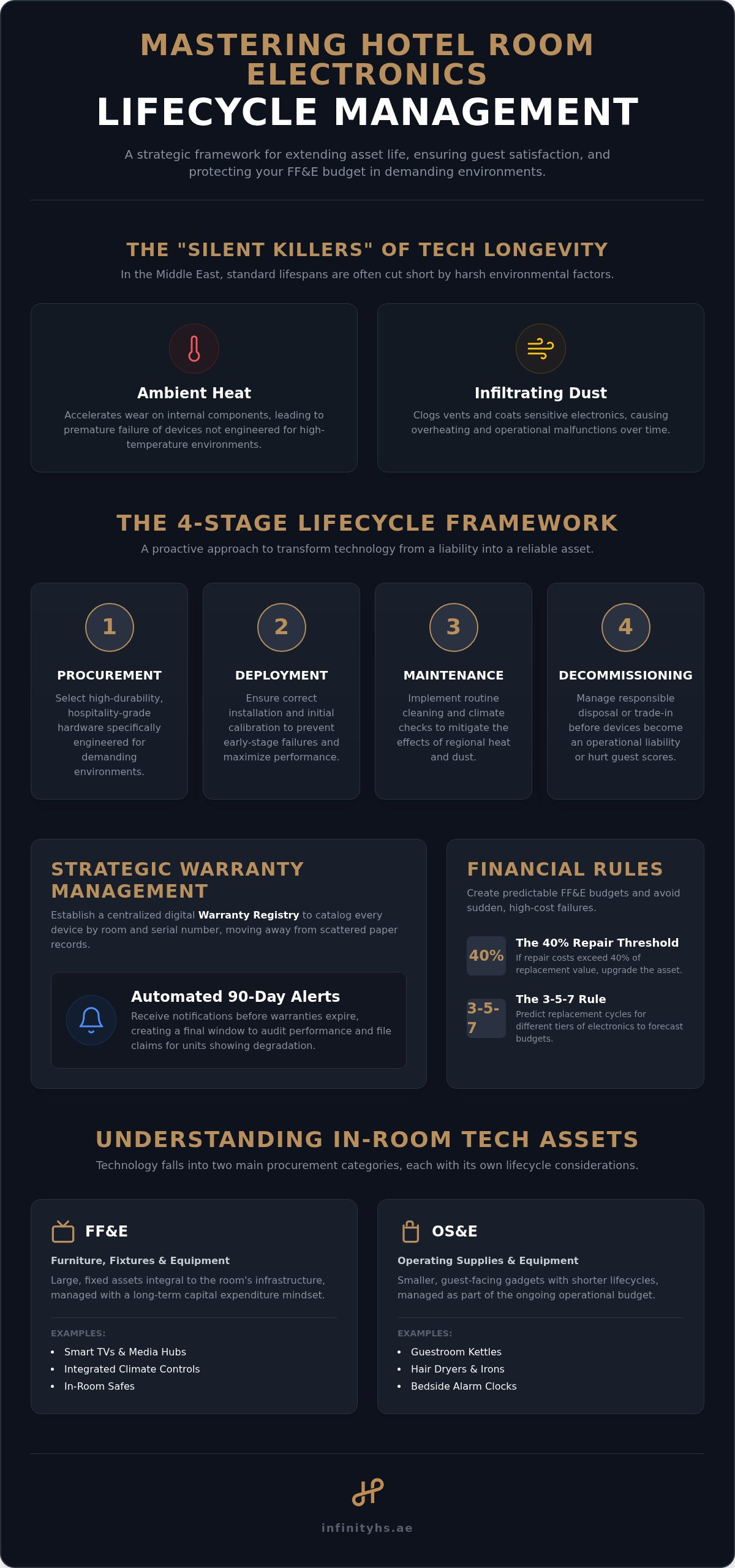
Effective hotel room electronics lifecycle management is a strategic discipline that transforms how a property handles its technology investments. Rather than treating gadgets as disposable items, this approach views them as critical assets with a defined lifespan. By implementing a structured framework, operators move away from a reactive "break-fix" model toward a proactive asset rotation schedule. This transition is essential for maintaining brand standards in Dubai, where the competitive landscape and high guest expectations leave no room for faulty hardware. A professional procurement partner plays a vital role here, capturing essential asset data like serial numbers and warranty start dates at the point of purchase to ensure your records are accurate from day one.
The process generally follows four distinct stages:
- Procurement: Selecting high-durability hardware, such as durable, hospitality-grade devices, that is specifically engineered for hospitality environments.
- Deployment: Ensuring correct installation and initial calibration to prevent early-stage failures.
- Maintenance: Implementing routine cleaning and climate checks to mitigate the effects of regional heat and dust.
- Decommissioning: Managing the responsible disposal or trade-in of devices before they become an operational liability.
The Cost of Inefficient Asset Tracking
Inaccurate data leads to significant financial leakage across a property. When maintenance teams lose track of warranty windows, the hotel often pays for expensive repairs that the manufacturer should've covered. Beyond these direct costs, "tech downtime" erodes guest satisfaction scores and can force a reduction in ADR if rooms must be taken out of service due to faulty equipment. Understanding the Fundamentals of Enterprise Asset Management helps managers see that value is preserved through consistent oversight. In a hospitality context, Total Cost of Ownership (TCO) is the sum of the initial purchase price plus all operational, maintenance, and energy costs incurred over the item's entire functional life.
Integrating Electronics into FF&E and OS&E Planning
Technology assets in a guestroom usually fall into two procurement categories. Large, fixed items like smart TVs, media hubs, and integrated climate controls are treated as Furniture, Fixtures, and Equipment (FF&E). Smaller, guest-facing gadgets such as kettles, hair dryers, or alarm clocks are classified as Operating Supplies and Equipment (OS&E). Exploring specialized OS&E solutions can help ensure these smaller items match the durability of your larger installations. For turnkey projects, procurement fees often include the setup of these lifecycle protocols, providing your team with a clear roadmap for replacements and upgrades from the moment the hotel opens.
Strategic Warranty Management for Hotel Electronics
Managing warranties for a single television is straightforward; managing them for five hundred units across a sprawling resort is a complex logistical challenge. Within the framework of hotel room electronics lifecycle management, your warranty strategy must be centralized and digitized from the moment of bulk procurement. Storing paper receipts or scattered PDF invoices is no longer a viable option for modern operations. Instead, sophisticated operators establish a digital 'Warranty Registry' that catalogs every device by room number and serial number. This system should be configured to trigger automated alerts 90 days before a warranty expires, giving your engineering team a final window to audit performance and file claims for any units showing early signs of degradation.
Bulk Warranty Tracking Best Practices
To simplify the claims process, use serial number batching. This allows you to group devices by their purchase date and production run, making it easier to identify batch-wide defects. Internal ownership is equally critical. Assigning a specific team member within the IT or engineering department to conduct quarterly warranty audits ensures that no coverage lapses unnoticed. A global hotel procurement company acts as a vital manufacturer liaison during this phase, leveraging high-volume relationships to expedite Return Merchandise Authorization (RMA) approvals. These partners can often negotiate 'Hospitality-Specific' terms, such as on-site repair or advanced replacement, which far exceed standard consumer-grade protection.
Navigating Middle East Warranty Limitations
Procuring electronics in the GCC requires a nuanced understanding of regional support networks. One common pitfall is the acquisition of 'gray market' products. These units might offer a lower initial price, but they often lack valid local support and regional parts availability. Additionally, regional power fluctuations can cause premature failure in sensitive components like internal capacitors. Standard warranties may exclude damage caused by electrical surges unless specific hospitality-grade surge protection is integrated into the room's design. Robust local GCC representation is essential for warranty enforcement because it provides a direct, physical point of contact for resolving disputes with international manufacturers. If you are looking to refine your regional procurement strategy, you can consult with our logistics experts to ensure your assets are fully protected under regional law.
Environmental Impact on Tech Longevity in the GCC and Africa
Environmental factors in the GCC and Africa present a unique set of challenges for hotel room electronics lifecycle management. While standard consumer tech might survive in temperate climates, the extreme ambient heat of the Middle East accelerates the degradation of internal capacitors. These components are sensitive to thermal stress; when they fail, the entire device often becomes e-waste. Dust ingress acts as a silent killer for in-room connectivity hubs and smart TVs, as fine desert sand bypasses standard ventilation filters to coat internal boards. In coastal cities, high humidity levels lead to PCB (Printed Circuit Board) corrosion, causing short circuits that are difficult to repair. To combat these issues, operators should select hardware with specialized heat-dissipation housings, such as LOVO products, which are engineered specifically for high-turnover hospitality environments in demanding climates.
Climate-Aware Sourcing Strategies
Sourcing for these regions requires a climate-first mindset. When evaluating tech for balconies or semi-outdoor lounges, check the IP (Ingress Protection) ratings to ensure resistance to both solid particles and liquid moisture. Choosing energy-efficient electronics is another vital strategy; these units generate less internal heat, which directly extends the life of the motherboard. Additionally, given the inconsistent power grids in parts of Africa and the GCC, integrated surge protection is not an optional luxury but a foundational requirement to prevent catastrophic voltage damage.
Preventive Maintenance for Extended Lifespan
Preventive maintenance is the most effective way to protect your investment. Establish a quarterly cleaning schedule where engineering teams use compressed air to clear ventilation ports on all guestroom devices. This simple step prevents heat buildup and reduces fan strain. Firmware update cycles also play a role; while security is paramount, you must balance updates with hardware performance to avoid software bloat that can slow down older processors. Finally, train your housekeeping staff to spot early signs of hardware fatigue, such as flickering screens or unusual fan noise, during their standard room turns. Catching a failing unit early can prevent a guest complaint and allow for a more cost-effective repair before the warranty period lapses.
Replacement Cycles: When to Repair vs. When to Upgrade
Determining the exact moment to retire an asset is the cornerstone of effective hotel room electronics lifecycle management. You need a data-driven approach rather than relying on visual wear or guest complaints to trigger a purchase. A reliable industry benchmark is the 40% Repair Threshold. If the cost of parts and labor for a single repair exceeds 40% of the price of a brand new unit, the asset should be decommissioned. Repairing aging tech beyond this point often leads to diminishing returns; secondary components likely face imminent failure due to the same environmental stressors that caused the initial breakdown.
Category-Specific Lifespan Benchmarks
Not all electronics age at the same rate. The "3-5-7 Rule" provides a structured timeline for your FF&E and OS&E planning. Smart TVs and connectivity hubs typically offer a functional life of 5 to 7 years before software obsolescence or backlight degradation occurs. Conversely, guest charging stations and universal docks often require replacement every 3 years due to heavy physical use and evolving connector standards. For high-turnover OS&E items like in-room coffee systems and kettles, the lifespan can be even shorter. You can find specialized data for high-moisture environments by reviewing Infinity's bathroom electronics, where components like hair dryers face unique operational demands that differ from bedroom tech.
Budgeting for Multi-Phase Renovations
Staggering your electronics replacement is a strategic way to avoid massive capital expenditure spikes that can disrupt your annual budgeting. By implementing a phased rollout, you can replace tech in one wing or floor at a time. This ensures that the property always maintains a high standard without a singular, overwhelming financial hit. Value engineering plays a vital role here; it involves finding the precise balance between premium guest features and the long-term durability required for hospitality. Professional turnkey procurement fees often cover the complex logistics of these phased rollouts, including the coordination of deliveries and the removal of old units. Standardizing your guest room tech across the property simplifies this process and makes spare parts inventory management far more efficient.
The final stage of the cycle involves secure data wiping and sustainable disposal. Modern smart TVs and media hubs store guest credentials and network data that must be professionally cleared to ensure privacy compliance. When an asset finally reaches its end-of-life, the decommissioning process must be handled with meticulous care. Beyond data security, sustainable disposal ensures that your property adheres to local environmental regulations regarding electronic waste, preserving your brand's reputation for corporate responsibility.
Optimizing Your Tech Stack with Infinity Hotel Supplies
Infinity Hotel Supplies serves as a meticulous facilitator for operators who require more than just a vendor; they need a long-term partner. We manage the entire scope of hotel room electronics lifecycle management by overseeing every detail from initial factory sourcing to final on-site support. Our flagship brand, LOVO Premium Electronics, provides a distinct advantage because it's engineered specifically for the rigors of Middle Eastern hospitality. These devices aren't off-the-shelf consumer products. They're high-durability solutions designed to withstand the high-turnover nature of luxury properties while maintaining peak performance in demanding regional climates.
Our global operational footprint allows us to maintain a steady hand on the entire supply chain. With dedicated offices in Dubai and China, we conduct rigorous quality control inspections before any shipment leaves the warehouse. This dual-market presence ensures that logistics are handled with ease and that every unit meets our strict internal benchmarks. We don't just deliver boxes; we provide a comprehensive methodology that secures your investment and guarantees operational excellence.
Turnkey Support for New Developments
Integrating technology into a new property requires foresight and precision. We provide seamless integration of electronics into your property’s initial FF&E package, ensuring that your tech stack aligns perfectly with your interior design and brand standards. Our team stays with you long after the grand opening, acting as your local advocate for warranty management and future replacement planning. This partnership approach prevents the budget spikes and technical failures that often plague new developments. You can reach out to our contact team for bespoke project quotes that reflect your specific room count and technical requirements.
Global Reach, Local Expertise
Navigating the regulatory landscape of the GCC and Africa is a complex task that requires specialized knowledge. We ensure that every product in our catalog meets necessary regional safety and power certifications, protecting your property from the risks associated with non-compliant hardware. Our commitment to sustainable sourcing means we prioritize energy-efficient room electronics that reduce your property's carbon footprint while lowering utility costs. This blend of global sourcing power and local technical expertise makes Infinity the reliable ally you need to maintain a sophisticated guest experience.
Securing Your Property’s Technical Future
Success in 2026 requires moving beyond simple procurement toward a disciplined strategy of hotel room electronics lifecycle management. By implementing the 3-5-7 rule and strictly adhering to the 40% repair threshold, you can eliminate budget volatility and ensure your guests always enjoy a seamless digital experience. Protecting these assets from regional environmental stressors is not just a maintenance task; it's a fundamental preservation of your capital investment.
Since 2014, Infinity Hotel Supplies has provided turnkey OS&E and FF&E solutions that bridge the gap between global manufacturing and local operational needs. As the exclusive distributor of LOVO Premium Electronics, we offer hardware specifically hardened for the Middle Eastern climate. Our offices in Dubai, the UK, and China maintain total quality control over every unit we deliver, ensuring your tech stack remains a reliable asset for years to come.
We look forward to helping you build a more resilient and cost-effective technology stack that reflects the excellence of your brand.
Frequently Asked Questions
How often should a hotel replace its in-room smart TVs?
Smart TVs in high-traffic hotels generally require replacement every five to seven years. While the hardware might still function, software obsolescence often prevents modern streaming apps from running smoothly. Additionally, backlight intensity tends to diminish over thousands of hours of use. Regular firmware updates can extend this window slightly, but the 3-5-7 rule remains the most reliable benchmark for maintaining premium guest standards across your property.
What is the typical warranty period for bulk hotel room electronics?
Standard warranty periods for hospitality-grade electronics typically range from one to three years. These terms differ from consumer warranties because they account for 24/7 usage cycles and higher turnover rates. When negotiating bulk orders, procurement partners can often secure extended coverage or specialized on-site repair terms. It's essential to document the exact start date for every unit to maximize your coverage during the early stages of the asset life.
How does the Middle Eastern climate affect electronic warranties?
The Middle Eastern climate can lead to premature hardware failure, which some manufacturers may classify as environmental abuse rather than a defect. High ambient heat and fine dust ingress can void standard warranties if the equipment isn't specifically rated for these conditions. Utilizing specialized hardware like LOVO Premium Electronics ensures that your tech is engineered for regional extremes, protecting your warranty claims from being rejected due to climate-related wear.
Can a procurement company help with warranty claims after the project is finished?
A dedicated procurement partner continues to serve as a manufacturer liaison long after the initial installation. This support is a critical component of hotel room electronics lifecycle management, as it provides you with a local advocate to manage Return Merchandise Authorizations (RMAs). Having a representative with offices in Dubai and China ensures that technical disputes are resolved quickly without the delays of dealing with international headquarters.
What is the difference between an international warranty and a local GCC warranty?
Local GCC warranties provide access to regional service centers and locally stocked spare parts, which are vital for minimizing room downtime. International warranties often require the hotel to ship faulty units back to the country of origin, incurring high logistics costs and lengthy delays. A local warranty guarantees that technicians can provide on-site support, ensuring your property maintains operational continuity without the risk of "gray market" support limitations.
Are there specific electronics designed for high-turnover hotel environments?
Yes, brands like LOVO Premium Electronics are specifically engineered for the high-turnover rigors of the hospitality industry. These products feature hardened internal components, such as high-grade capacitors and heat-dissipation housings, that standard consumer electronics lack. By choosing hardware designed for constant use and regional environmental stress, you significantly lower your total cost of ownership and reduce the frequency of emergency replacements during peak seasons.
How do I track warranties for thousands of individual room items?
The most effective way to track thousands of assets is through a centralized Digital Warranty Registry. This system catalogs every device by its unique serial number and room location. By integrating this registry into your hotel room electronics lifecycle management strategy, you can set automated alerts for upcoming expirations. This proactive approach allows your engineering team to audit units and file necessary claims before the coverage window closes.
What happens to old hotel electronics during a renovation?
During a renovation, old electronics must undergo a secure data wiping process to protect guest privacy and network security. Once cleared, the items should be disposed of through certified electronic waste (e-waste) channels to comply with regional environmental regulations. Some procurement partners also offer buy-back or trade-in programs, allowing you to recoup a small portion of the initial investment while ensuring the hardware is recycled responsibly.

Article by
Infinity Editorial Team
With deep expertise in hospitality product FF&E and OS&E across the Middle East and Africa, Infinity Editorial Team brings insights from Infinity Hotel Supplies, helping developers, hoteliers, and homeowners transform spaces from empty shells to fully furnished, design-ready environments.
Disclaimer
The content published by Infinity Editorial Team is intended for informational purposes only. All articles, guides, and insights are based on industry knowledge and experience in hospitality FF&E and OS&E supply across the Middle East and Africa. Infinity Hotel Supplies does not guarantee specific outcomes and recommends consulting a qualified professional for project-specific requirements.


