

Did you know that fewer than 10% of electronics producers in South Africa are currently meeting their strict 2026 e-waste compliance obligations? This regulatory shift highlights a deeper reality: sourcing durable hotel electronics for African climates is no longer about finding the lowest price, but about securing hardware engineered for thermal resilience and power stability. You've likely seen standard consumer-grade devices buckle under the pressure of intense humidity or persistent dust, leading to inflated replacement costs and frustrated guests.
We understand that "durable" isn't a marketing term in the hospitality sector; it's a technical requirement for survival. This 2026 guide will help you master the complexities of hospitality procurement for harsh environments, ensuring you secure resilient, energy-efficient equipment that lasts. We will examine the technical necessity of specific Ingress Protection ratings, the impact of new energy efficiency standards in Ghana, and how to build a supply chain that eliminates the logistical headaches of remote maintenance. By the end of this guide, you'll have a roadmap for reducing operational costs while maintaining the high-end guest experience your brand demands.
Key Takeaways
- Identify the specific technical specifications, such as Ingress Protection (IP) ratings, required to protect internal components from heat, dust, and humidity.
- Master the complexities of sourcing durable hotel electronics for African climates by prioritizing hospitality-grade hardware over standard consumer alternatives.
- Reduce long-term operational overhead by sourcing low-wattage technology that complies with evolving regional energy efficiency regulations.
- Transition from upfront cost comparisons to a Total Cost of Ownership (TCO) model that accounts for maintenance, energy, and replacement cycles.
- Leverage a global supply chain partner to navigate African logistics and secure turnkey OS&E and FF&E solutions with reliable regional support.
Understanding the Environmental Challenges for Hotel Electronics in Africa
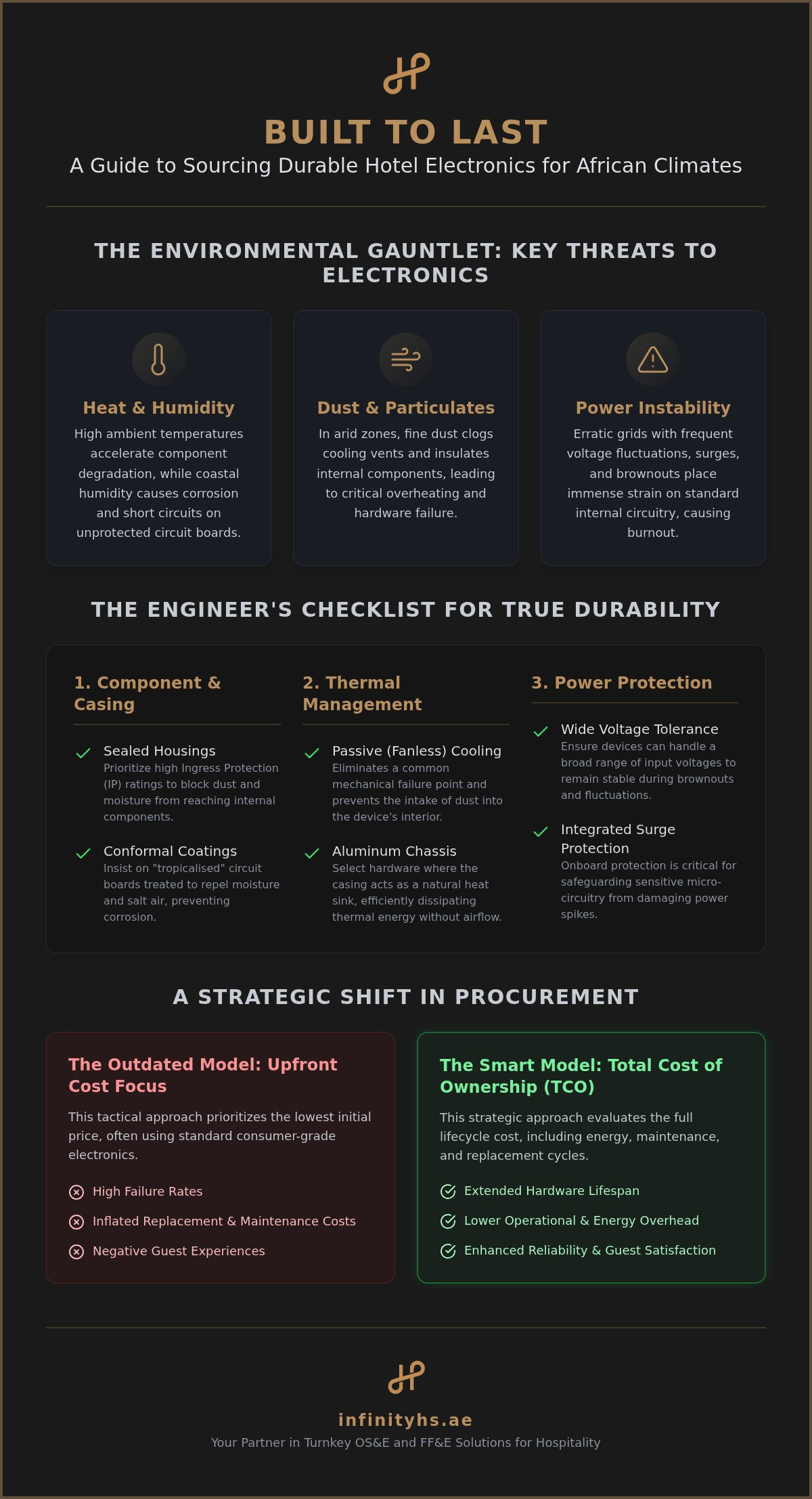
The African hospitality landscape presents a unique set of stressors that standard consumer electronics simply aren't built to withstand. When we discuss sourcing durable hotel electronics for African climates, we're addressing a technical battle against heat, moisture, and airborne particulates. High ambient temperatures act as "silent killers," accelerating the degradation of capacitors and internal power supplies. In many regions, these temperatures don't just peak; they remain consistently high, leading to thermal throttling and eventual hardware failure in devices designed for temperate environments.
These environmental challenges in Africa are compounded by erratic power grids. Voltage fluctuations, brownouts, and sudden surges are common, placing immense strain on the internal circuitry of guest room technology. Without robust internal protection, these power events can render an entire floor's electronics obsolete in a single afternoon. This makes the procurement of hardware with integrated surge protection and wide voltage tolerance a necessity rather than an optional upgrade.
The Impact of Heat and Humidity on Hospitality Hardware
In coastal regions, humidity is the primary catalyst for corrosion. Moisture-laden air penetrates standard casings, leading to oxidation on circuit boards and eventual short circuits. Professional hospitality hardware often undergoes "tropicalisation," a process where internal components are treated with conformal coatings to repel moisture and salt air. Sourcing durable hotel electronics for African climates requires a shift from consumer-grade plastics to materials that facilitate better heat dissipation. Devices that lack adequate thermal management will see their lifespans halved in tropical zones, directly impacting your property's replacement cycle and operational budget.
Arid Zones and the Challenge of Fine Particulates
For desert resorts and arid interior regions, dust ingress is the most persistent threat. Standard cooling vents act as gateways for fine particulates, which settle on internal heat sinks and act as insulation, causing components to overheat. We recommend prioritizing hardware with sealed housings and fanless cooling systems. Fanless designs eliminate the mechanical failure point of a spinning fan while preventing the "vacuum effect" that pulls dust into the device. Consider the following when evaluating hardware for arid zones:
- Sealed Housings: Prioritize devices with higher Ingress Protection (IP) ratings to block micro-dust.
- Passive Cooling: Select electronics with aluminum chassis that act as a natural heat sink, removing the need for internal airflow.
- Maintenance Protocols: Implement a rigorous schedule for exterior cleaning to prevent surface buildup from migrating into ports and connections.
By understanding these environmental realities, procurement managers can move beyond simple price-point comparisons. The goal is to select hardware that maintains peak performance despite the atmospheric pressures it will face every day.
Technical Specifications: Key Durability Features to Look For
Precision engineering is the cornerstone of reliability. Sourcing durable hotel electronics for African climates requires a shift from aesthetic-led buying to engineering-led procurement. While a standard consumer device might appear identical to a professional alternative, the internal architecture tells a different story. True durability is found in the technical specifications that address thermal management, moisture resistance, and mechanical resilience.
Modern hospitality properties often face unique infrastructure challenges. While energy infrastructure continues to evolve toward universal access to modern and affordable energy, hotel operators must prioritize efficiency to offset the costs of power-stressed grids. This involves selecting hardware with wide-input voltage tolerances and reinforced capacitors that can survive the frequent power cycles common in developing regions.
Deciphering IP Ratings for African Resorts
The IP rating, defined by the International Electrotechnical Commission (IEC) standard 60529, is a two-digit code that indicates the level of protection against solids and liquids. For example, a rating of IP65 indicates a device is "dust-tight" and protected against low-pressure water jets. For hotels in arid regions like the Sahel or the Kalahari, the first digit is critical. A rating of 5 or 6 ensures that fine sand doesn't penetrate the casing to cause internal friction or overheating. In coastal environments, the second digit becomes the priority, as it signifies protection against the corrosive effects of salt-laden moisture.
Why Hospitality-Grade Electronics (LOVO) Outperform Consumer Brands
Professional solutions like LOVO Premium Electronics are designed for the high-duty cycles of the hospitality industry. Unlike consumer brands that are built for a few hours of daily use, these devices are engineered for continuous 24/7 operation. This is achieved through the use of fire-retardant materials and specialized internal cooling systems that don't rely on dust-prone intake fans. When you invest in room electronics specifically built for hotels, you're securing hardware that includes:
- Reinforced Power Supplies: Built to handle the surges and brownouts that destroy standard consumer circuitry.
- Anti-Corrosive Coatings: Conformal coatings on PCBs that prevent moisture-induced short circuits.
- Passive Thermal Management: High-grade aluminum heat sinks that dissipate heat without the need for vulnerable mechanical fans.
Our team can provide a detailed technical consultation to help you match hardware specs to your specific micro-climate, ensuring your investment remains protected for years to come. By prioritizing these technical features, you move beyond tactical buying toward a model of long-term operational stability.
Sourcing Energy-Efficient Hotel Electronics for Power-Stressed Regions
In power-stressed regions, energy efficiency is a strategic imperative rather than a sustainability checkbox. High-wattage devices generate significant internal heat, compounding the external thermal stress we established in the previous sections. By prioritizing low-wattage technology, procurement managers reduce the internal thermal load, directly extending the operational lifespan of the hardware. This dual benefit lowers energy bills while simultaneously reducing the frequency of hardware failures across the property.
Operational excellence in 2026 requires a deep understanding of evolving regional regulations. For instance, Ghana has phased in new energy efficiency regulations for air conditioners, requiring a minimum Annual Energy Efficiency Ratio (AEER) of 3.22 for inverter compressors as of December 2025. Sourcing durable hotel electronics for African climates involves aligning your procurement with these standards to avoid the "e-dumping" of inefficient, second-hand products that inflate your utility costs and fail prematurely.
Defining Energy-Efficient Sourcing in Hospitality
Energy efficiency serves as a primary durability feature because it indicates superior component quality. Hardware that meets the IEC 60721 series of standards for environmental testing often incorporates advanced thermal management that consumes less power. In the African hospitality market, every kilowatt saved is a minute added to the lifespan of your infrastructure. This is particularly relevant as countries like Tanzania move toward robust Minimum Energy Performance Standards (MEPS), with studies indicating potential savings of 5.1 terawatt-hours by 2035 through stricter appliance regulations.
Mitigating Power Instability with Smart Sourcing
Power grid instability remains a significant hurdle, with brownouts and surges acting as constant threats to guest room technology. While external stabilizers were once the norm, modern properties now favor electronics with integrated Automatic Voltage Regulation (AVR). Our LOVO Premium Electronics are engineered with these internal protections, allowing them to operate safely within wide voltage ranges without the need for bulky external accessories. This is especially vital for high-draw items found in our bathroom accessories range, such as hair dryers and shavers, which are often the first to fail during a surge.
Modern properties are also future-proofing their investments by sourcing solar-ready electronics. These devices are designed to handle the direct current (DC) or modified sine waves often produced by backup battery systems and solar inverters. By selecting hardware that remains stable during the transition from grid to backup power, you ensure a seamless guest experience while protecting your circuit boards from the "dirty power" that frequently causes standard consumer electronics to burn out.
Strategic Sourcing: Moving from Tactical Buying to Long-Term Reliability
Tactical buying is a luxury that remote hospitality sites cannot afford. While a low initial invoice might look attractive on a quarterly budget, it often masks the true costs of hardware failure and logistical friction. Sourcing durable hotel electronics for African climates requires a transition toward a holistic reliability model. This strategy prioritizes hardware that can withstand the environmental stressors we've established while accounting for the complex regulatory and tax landscapes across the continent. By moving away from fragmented, one-off purchases, operators can secure a more stable guest experience and a healthier bottom line.
The TCO Framework for Remote Hospitality Sites
Calculating the Total Cost of Ownership (TCO) is essential for properties in high-duty zones. Beyond the purchase price, you must factor in the "border burden" and the cost of replacement logistics. For example, in Kenya as of 2026, imported electronics face a 25% duty, a 16% VAT, and additional fees like the 1.5% Railway Development Levy. When a device fails prematurely, you aren't just losing the hardware; you're losing the sunk cost of these non-refundable duties. Effective Hotel Room Electronics Lifecycle Management involves planning for these variables from the initial project phase. Sourcing durable hotel electronics for African climates means investing in hardware that minimizes these recurring tax and shipping events over a five-year horizon.
Managing Warranties and After-Sales Support in Africa
Warranty management is often where standard procurement models break down. Sourcing from a partner with a regional hub provides a distinct "Dubai Advantage," allowing properties to bypass the delays of intercontinental shipping. By leveraging a supply chain centered in a global logistics hub, hotels can secure faster after-sales support and a more reliable flow of spare parts. This is a core component of upgrading hotel room electronics in Dubai and the surrounding African markets. It ensures that your property isn't left with non-functional inventory due to the lack of local technical support or specialized components.
Turnkey procurement simplifies the fragmented supply chains that often plague large-scale developments. Instead of managing dozens of disparate vendors, a single-source partner facilitates the entire methodology, overseeing quality control in China and final delivery in Nigeria, Morocco, or South Africa. This meticulous facilitator role ensures that every component, from LOVO Premium Electronics to custom FF&E solutions, meets a unified standard of excellence. This integrated approach reduces the risk of hardware mismatches and ensures that all room technology operates within a synchronized, protected ecosystem.
Partnering for Success: How Infinity Hotel Supplies Simplifies African Procurement
Navigating the complexities of African hospitality requires more than a vendor; it demands a global partner with a meticulous eye for detail. Since 2014, we've positioned ourselves as a comprehensive provider of turnkey OS&E and FF&E solutions. We bridge the gap between manufacturing hubs and remote property sites, ensuring that the process of sourcing durable hotel electronics for African climates is seamless and risk-managed. By acting as a single point of contact, we eliminate the fragmentation that leads to project delays and hardware mismatches.
Our global footprint is a strategic asset for your procurement team. With established offices in the UAE, China, and the UK, we maintain rigorous quality control standards at the source. This global presence allows us to vet every piece of LOVO Premium Electronics before it leaves the factory, ensuring compliance with the technical specifications established in this guide. We don't just ship products; we manage the entire methodology of supply, from initial design alignment to final delivery in your guest rooms. This established reliability offers a sense of security to hospitality operators who require seamless, large-scale solutions across the continent.
Customization is another pillar of our service model. We understand that your room technology should reflect your brand's unique identity. Whether you require custom-branded leather accessories or specifically configured room electronics, our team ensures that durability doesn't come at the expense of aesthetic cohesion. This attention to detail extends to our bulk orders, where we maintain consistency across large-scale developments. Our persona is that of a meticulous facilitator, ensuring every small detail aligns with your property’s high-end guest experience.
Streamlining Hospitality Logistics in Emerging Markets
The logistical landscape in Africa is notoriously complex, with varied customs regulations and infrastructure challenges. Our experience in emerging markets allows us to navigate these hurdles with ease, managing freight and clearance so you can focus on guest experience. We offer comprehensive turnkey packages that include everything from LOVO electronics to essential room accessories. This all-encompassing support is particularly valuable for new hotel developments where timeline synchronization is critical for a successful pre-opening phase.
Ready to Equip Your Property for the African Climate?
Sourcing durable hotel electronics for African climates is a technical challenge that requires foresight and expertise. From managing thermal stress to navigating 2026 energy regulations, the choices you make today will define your property's operational efficiency for years to come. We're dedicated to helping you secure hardware that is as resilient as it is refined. Our steady, experienced hand manages every detail of the supply chain with care and foresight.
Securing the Future of Your African Hospitality Development
Mastering the complexities of sourcing durable hotel electronics for African climates requires a departure from short-term procurement habits. By prioritizing technical specifications like high IP ratings and integrated voltage regulation, you protect your property against the unique environmental and infrastructure stressors of the continent. Moving toward a Total Cost of Ownership model ensures that your investment remains resilient and energy-efficient through 2026 and beyond.
Infinity Hotel Supplies serves as your dedicated partner in this journey, offering LOVO Premium Electronics specifically engineered for the rigors of hospitality. Since 2014, we've refined our expertise in GCC and African logistics to provide comprehensive OS&E and FF&E solutions from a single, reliable source. Our global footprint across the UAE, China, and the UK guarantees that every component meets the highest standards of quality control before it reaches your property.
We're here to help you navigate every logistical detail with precision and care, ensuring your property stands as a hallmark of excellence and operational stability.
Frequently Asked Questions
What are the most durable electronics for hotels in high-humidity areas?
Conformal-coated circuit boards and hardware with passive cooling are the most resilient choices for humid zones. These "tropicalised" devices prevent the moisture-induced oxidation that typically causes standard electronics to short-circuit. By sourcing durable hotel electronics for African climates that feature non-corrosive aluminum chassis, properties can maintain high guest standards without the constant threat of internal component failure.
How does energy-efficient sourcing reduce hotel operating costs in Africa?
Energy-efficient sourcing reduces costs by lowering both utility consumption and the internal thermal load of the hardware. High-efficiency devices generate less heat, which is a primary cause of hardware degradation in hot environments. This approach ensures compliance with regional energy standards while extending the replacement cycle of your equipment, ultimately protecting your long-term capital expenditure and reducing monthly overhead.
What is the difference between consumer and hospitality-grade electronics?
Hospitality-grade electronics are engineered for 24/7 continuous operation and feature fire-retardant materials that meet strict international safety certifications. Unlike consumer-grade brands designed for intermittent residential use, professional hardware like LOVO Premium Electronics includes integrated features like volume limiters and specialized power supplies. These units are built to withstand the rigorous usage patterns typical of a high-turnover hotel environment.
Can I use standard voltage stabilizers for all hotel room electronics?
While standard stabilizers provide basic protection, modern hospitality technology often incorporates internal Automatic Voltage Regulation (AVR) for superior reliability. Integrated protection is more efficient and eliminates the need for unsightly external boxes in guest rooms. Sourcing durable hotel electronics for African climates with built-in surge protection ensures that sensitive components remain safe during the power cycles common in many regional grids.
How do I manage international warranties for electronics in Africa?
Managing warranties effectively requires a procurement partner with a regional logistics hub, such as Dubai, to facilitate faster spare parts delivery and technical support. This model bypasses the logistical bottlenecks of returning faulty units to distant manufacturers. A localized support structure ensures that your property maintains operational continuity without the prohibitive costs and delays of intercontinental shipping for repairs.
What IP rating is recommended for outdoor hotel lighting in coastal regions?
We recommend an Ingress Protection rating of IP65 or higher for outdoor lighting and electronics in coastal African properties. This specific rating ensures the device is dust-tight and protected against the corrosive salt-laden moisture that characterizes seaside environments. Using lower ratings often leads to rapid internal corrosion, forcing premature replacements and increasing the overall maintenance burden for your facility team.
Why is Total Cost of Ownership (TCO) more important than the initial purchase price?
TCO is critical because it accounts for the cumulative costs of import duties, shipping, and energy consumption over a five-year period. In many African markets, duties and levies can exceed 40% of the hardware value, meaning frequent replacements are financially devastating. A higher initial investment in resilient hardware ultimately yields a lower cost per room night by minimizing these recurring logistical and tax expenses.
Does Infinity Hotel Supplies provide turnkey electronics for new hotel builds?
Yes, we specialize in turnkey OS&E and FF&E solutions, providing a single point of contact for new hotel developments across the continent. Our methodology covers everything from the initial sourcing of LOVO Premium Electronics to final quality control and delivery. This integrated approach simplifies the procurement process, ensuring that all guest room technology is climate-ready and perfectly aligned with your brand's aesthetic standards.

Article by
Infinity Editorial Team
With deep expertise in hospitality product FF&E and OS&E across the Middle East and Africa, Infinity Editorial Team brings insights from Infinity Hotel Supplies, helping developers, hoteliers, and homeowners transform spaces from empty shells to fully furnished, design-ready environments.
Disclaimer
The content published by Infinity Editorial Team is intended for informational purposes only. All articles, guides, and insights are based on industry knowledge and experience in hospitality FF&E and OS&E supply across the Middle East and Africa. Infinity Hotel Supplies does not guarantee specific outcomes and recommends consulting a qualified professional for project-specific requirements.


