

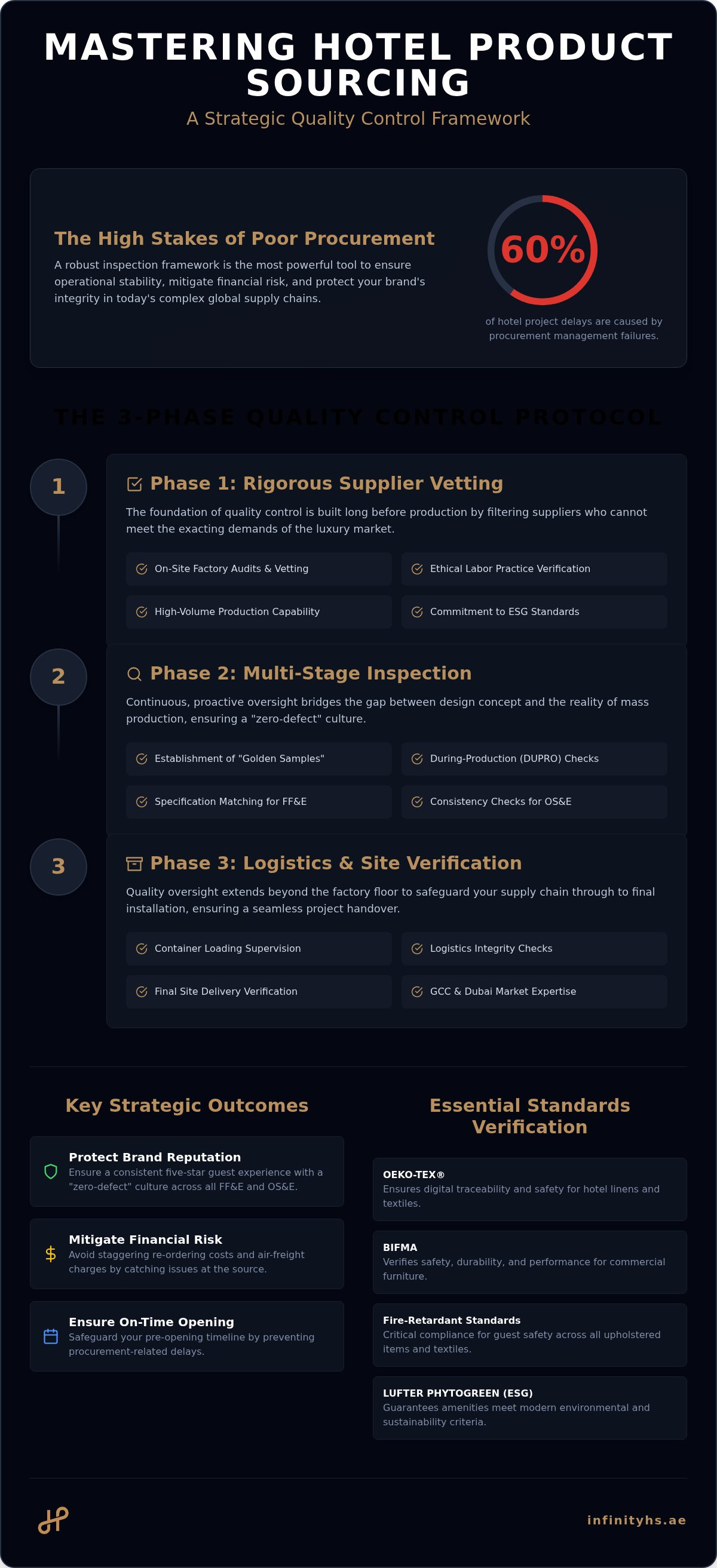
Nearly 60% of hotel project delays are now attributed to poor procurement management, a statistic that highlights the high stakes of modern global supply chains. When you're managing a complex rollout, the last thing you need is a shipment of linens that fails to meet the 2026 OEKO-TEX digital traceability standards or electronics that arrive with inconsistent specifications. Implementing a rigorous hotel product sourcing quality control program is no longer just a safeguard; it's a strategic necessity for maintaining your brand's integrity. We understand the frustration of receiving sub-standard OS&E or FF&E that doesn't align with your vision or your operational timeline.
This guide will help you master the end-to-end quality control protocols that safeguard your hotel's brand reputation and long-term efficiency. You'll gain a reliable, repeatable inspection framework that provides confidence in your global supplier partnerships, whether you're sourcing locally or directly from manufacturers. We'll walk through the practicalities of factory-floor inspections and the technical standards required to ensure your guest experience remains seamless and sophisticated from the moment of installation.
Key Takeaways
- Understand why quality control serves as a holistic risk-mitigation strategy essential for maintaining a consistent five-star guest experience across all OS&E and FF&E categories.
- Learn to implement a rigorous hotel product sourcing quality control framework that begins with on-site factory audits and manufacturer vetting in global production hubs.
- Master the multi-stage inspection protocol, from establishing "golden samples" as quality benchmarks to performing during-production (DUPRO) checks for large-scale orders.
- Discover how to safeguard your supply chain by extending quality oversight to container loading and final site delivery within the GCC and Dubai markets.
- Explore the strategic advantages of a turnkey procurement partner with an established presence in the UAE, China, and the UK to manage the entire project lifecycle.
The Strategic Role of Quality Control in Modern Hotel Procurement
Quality control in the hospitality sector has evolved far beyond the traditional "sample check" at a factory gate. In 2026, as the global hospitality market scales toward $5.82 trillion, Quality control serves as a holistic risk-mitigation strategy that protects both the guest experience and the developer's bottom line. It's the silent engine behind a seamless opening, ensuring that every piece of FF&E and OS&E matches the rigorous specifications of a luxury brand. For operators in the GCC and Middle East, where the expectation of "five-star" service is a baseline requirement, meticulous oversight is the only way to maintain a steady, reliable supply chain.
Effective hotel product sourcing quality control requires a shift in perspective. It's not a final hurdle to clear, but a continuous proactive lifecycle. With nearly 60% of hotel project delays currently attributed to procurement failures, a robust inspection framework is the most powerful tool an operator has to ensure operational stability. This process bridges the gap between a visionary design concept and the practical reality of mass production in global manufacturing hubs.
To better understand the complexities of international manufacturing oversight, watch this helpful video:
Protecting Brand Reputation Through Meticulous Standards
A hotel's brand reputation is built on the consistency of the guest's tactile experience. A single batch of substandard hotel linen that fails to meet the 2026 OEKO-TEX digital traceability standards can lead to immediate negative reviews and a loss of guest trust. We believe in establishing a "zero-defect" culture within the procurement pipeline. This means ensuring that leather accessories, uniforms, and room amenities aren't just high quality in isolation, but are identical across every room and every batch. When your OS&E is consistent, your brand message remains clear and professional.
Mitigating Financial Risk and Operational Delays
The financial consequences of a failed shipment extend far beyond the initial purchase price. If a batch of room electronics or furniture doesn't meet safety certifications like BIFMA or fire-retardant standards, the cost of re-ordering and air-freighting replacements can be staggering. Integrating comprehensive hospitality procurement solutions into your project management allows you to catch these issues at the source. By conducting hotel product sourcing quality control on the factory floor, you avoid the logistics surcharges and warehousing fees that often plague unmonitored projects. This proactive approach is the only way to safeguard your pre-opening timeline and ensure your property is ready for guests on day one.
Phase 1: Rigorous Supplier Pre-Qualification and Vetting
The foundation of any successful procurement project lies in the integrity of the manufacturers selected. In an era where supply chains are increasingly complex, effective hotel product sourcing quality control must begin long before a single item is manufactured. Establishing minimum criteria for hospitality manufacturers in global hubs, such as China and the UK, allows operators to De-Risk Supply Chains by filtering out suppliers who cannot meet the exacting demands of the luxury market. This vetting process is particularly critical for GCC developments where high-volume orders require absolute consistency.
We prioritize manufacturers who demonstrate a commitment to ethical labor practices and environmental sustainability. For instance, our LUFTER PHYTOGREEN standards ensure that amenities meet modern ESG criteria, which 92% of business travelers now prioritize. Before any contracts are signed, on-site factory audits are non-negotiable. These audits verify that the facility possesses the technical capacity and the quality management systems necessary to deliver high-end OS&E and FF&E solutions without compromise.
Global Manufacturer Audits and Certification
A comprehensive audit goes beyond reviewing paperwork. It involves verifying ISO certifications and hospitality-specific compliance, such as fire retardancy for textiles under ASTM E84 or EN 1021 standards. Having local offices in sourcing hubs like China provides a distinct advantage; our teams can conduct unannounced visits to observe actual production conditions. This level of scrutiny helps dismantle common misconceptions, as discussed in our guide on The Myths of Hospitality Procurement. By witnessing the factory's daily operations, we ensure they maintain the standards required for your brand's long-term stability.
Material Specification and Technical Verification
Precision in hotel product sourcing quality control is achieved through detailed technical specification sheets. For premium hotel linen, we define exact parameters including thread count, weave density, and GSM for towels to ensure they withstand the 200 to 300 industrial wash cycles expected in commercial use. Similarly, casegoods must meet BIFMA x5.5 certifications to guarantee durability for a seven to ten year lifecycle.
Technical verification also extends to room electronics. Our LOVO premium electronics are engineered to meet specific voltage requirements and safety standards for international hotel environments. We test raw materials and components at the source to prevent the use of inferior substitutes. If you're looking to establish a more resilient supply chain for your next project, you can contact our specialist team to discuss your specific technical requirements. This meticulous attention to the finer details ensures that every product delivered to your site is fit for purpose and matches your brand's prestige.
Phase 2: The Multi-Stage Inspection Protocol
Once a manufacturer is successfully vetted, the focus of hotel product sourcing quality control shifts directly to the production floor. This phase begins with the "golden sample," a physical prototype that represents the absolute standard for every subsequent item in the order. This sample is signed off by all parties and serves as the ultimate benchmark during every stage of the manufacturing process. Establishing this clear baseline is a core principle found in any academic overview of hotel procurement, as it eliminates ambiguity between the designer's intent and the factory's actual output.
In the luxury hospitality sector, we apply rigorous Acceptable Quality Limit (AQL) standards that exceed standard consumer requirements. While mid-scale projects might tolerate minor variations, a five-star property demands absolute precision. We typically set AQL levels that prioritize the guest's tactile and visual experience, ensuring that even minor discrepancies in stitching, finish, or material density are identified and rectified. This meticulous approach prevents the operational friction and brand erosion that occurs when substandard equipment arrives at a site.
During Production (DUPRO) and In-Line Inspections
DUPRO serves as the critical midpoint check that prevents mass-production errors by identifying defects when only 20% to 30% of the order is complete. For complex operational equipment like housekeeping trolleys, these inspections focus on structural integrity, such as welding strength and the smooth operation of casters under load. We also verify color consistency across large batches of uniforms or upholstery, ensuring that dye lots remain uniform across the entire shipment. Catching a color shift or a structural flaw early allows the factory to adjust the process immediately without derailing the entire project timeline.
Pre-Shipment Inspection (PSI) Protocols
The Pre-Shipment Inspection is the final gatekeeper in the procurement lifecycle. This stage involves a comprehensive verification of the total quantity, export packaging durability, and individual product functionality before the final balance payment is released. It's at this point that we perform final stress tests on LOVO room electronics to guarantee "plug-and-play" readiness for your on-site engineering team. For guest amenities like our Phytogreen range, we ensure every unit is hermetically sealed and labeled according to specific GCC regulatory requirements. This final verification provides the confidence that the products arriving at your loading dock are 100% compliant with your established brand standards.
Phase 3: Logistics Integrity and Final Site Verification
Even the most meticulously crafted products are vulnerable during the thousands of miles of transit between a global manufacturing hub and a hotel site in Dubai. Comprehensive hotel product sourcing quality control must extend beyond the production line to include the physical handling and movement of goods. Without strict oversight during the logistics phase, the investment made in high-quality FF&E and OS&E remains at risk of transit damage or incorrect loading. It's a stage where precision is paramount, as industry data suggests that US hotel developers often maintain a 15% contingency fund specifically for logistics surcharges and warehousing fees. Strategic management at this point ensures that the final delivery aligns perfectly with the project’s operational timeline.
We don't just track orders; we manage the physical integrity of the shipment from the factory floor to the guest room. This proactive approach is the most effective way to maintain pre-opening timelines and avoid the high cost of air-freighting replacements for damaged goods. In the GCC market, where luxury standards are non-negotiable, the logistics chain is as critical as the manufacturing process itself.
Container Loading Supervision (CLS)
Supervision at the point of origin is the only way to verify that the items being shipped are exactly what was inspected and approved. Our teams ensure that containers are clean, dry, and seaworthy before loading begins. We pay particular attention to weight distribution; placing heavy furniture at the base and lighter, fragile items like bathroom accessories on top prevents crushing during sea transit. For projects requiring delicate electronics or temperature-sensitive amenities, monitoring the environment within the container is a standard part of our risk-mitigation protocol. It's a meticulous process that prevents the "container rain" or shifting loads that often lead to costly insurance claims.
Post-Delivery Inspection and Installation
Final site verification is especially critical for room electronics and integrated bathroom fixtures. We ensure that every component is installed to the exact technical specification, confirming that the "plug-and-play" readiness verified during factory testing translates to a functional guest room. This hands-on approach guarantees that the final aesthetic and functional experience matches the original vision of the hotelier. If you are planning a large-scale rollout in the Middle East and require professional oversight for your logistics, you can contact our team for a consultation to ensure your project remains on schedule and within budget.
Scaling Quality: The Benefits of a Turnkey Procurement Partner
Managing a global supply chain requires more than just logistical oversight; it demands a physical presence at every critical juncture of the production cycle. While digital procurement platforms offer visibility, they cannot verify the tactile quality of a textile or the structural finish of a custom furniture piece. A turnkey solution integrates hotel product sourcing quality control into the entire project lifecycle, moving beyond transactional buying toward a partnership-based model. This holistic approach ensures that your brand standards are upheld from the first factory audit to the final installation in a guest room. Outsourcing these complex protocols to a specialist is often more cost-effective than maintaining an internal team, as it eliminates the overhead of international travel and specialized training while providing immediate access to established manufacturer networks.
Stability is the ultimate luxury in hospitality development. By consolidating FF&E and OS&E requirements under a single provider, operators reduce the risk of communication gaps that lead to batch inconsistencies. We act as a meticulous facilitator, ensuring that the vision of the interior designer translates perfectly into the practicalities of mass manufacturing. This unified methodology protects your investment and ensures that every room meets the high-end expectations of the 2026 traveler.
The Global Hub Advantage: UAE, China, and UK
Operating across global offices in the UAE, China, and the UK provides a strategic advantage that few internal procurement departments can match. Our presence in China allows for real-time, on-site hotel product sourcing quality control, enabling us to resolve manufacturing issues the moment they arise. Meanwhile, our UK office ensures that European design standards and technical specifications are clearly communicated to production teams. This global footprint creates a seamless bridge between diverse regulatory environments and manufacturing cultures. Real-time communication between these hubs speeds up the resolution of quality disputes, ensuring that projects in the GCC stay on track despite the complexities of international trade.
Future-Proofing Your Supply Chain for 2026
The hospitality landscape of 2026 demands a shift toward sustainable materials and integrated smart room technologies. Modern procurement must adapt to these changes by implementing QC processes that verify the longevity of eco-friendly fabrics and the "plug-and-play" reliability of advanced electronics. Transparency and detailed reporting have become the new benchmarks for success. We provide comprehensive documentation for every inspection, offering you total confidence in the integrity of your supply chain. This level of detail is essential for maintaining brand reputation in an increasingly scrutinized market. To ensure your next project benefits from this meticulous level of oversight and global expertise, you can partner with Infinity Hotel Supplies for your next turnkey project. We are dedicated to delivering excellence and operational efficiency through every phase of the procurement journey.
Mastering Global Supply Chain Integrity for Your Next Opening
In the competitive landscape of luxury hospitality, the difference between a successful launch and a costly delay often rests on the rigor of your oversight. We've explored how a proactive approach to hotel product sourcing quality control transforms procurement from a logistical hurdle into a strategic asset. By prioritizing on-site factory audits and implementing multi-stage inspection protocols, you safeguard your property's reputation and protect its long-term operational stability.
A turnkey partnership provides the steady hand needed to navigate these international complexities with ease. Since 2014, Infinity Hotel Supplies has acted as a dedicated facilitator for prestigious developments, maintaining on-the-ground QC teams in the UAE, China, and the UK. Our end-to-end methodology ensures that every piece of FF&E and OS&E matches your original vision while meeting the stringent global standards of 2026. This comprehensive support allows you to focus on the guest experience while we manage the finer details of the supply chain.
Discover how Infinity Hotel Supplies manages your global procurement quality control to ensure your next project is delivered with precision and excellence. Your commitment to quality is the foundation of a remarkable guest journey, and we are here to ensure that foundation remains unshakable.
Frequently Asked Questions
How do hotels ensure quality control when sourcing products from overseas?
Hotels ensure quality through a structured, multi-stage protocol that begins with rigorous factory audits and the approval of a "golden sample." Maintaining a physical presence in manufacturing hubs like China allows for unannounced inspections and real-time verification of technical specifications. This on-the-ground oversight is the only reliable way to bridge the gap between local design expectations and international production realities.
What is the difference between DUPRO and Pre-Shipment Inspection in hospitality?
DUPRO, or During Production inspection, occurs when approximately 20% to 30% of an order is complete to identify and correct defects early in the cycle. Pre-Shipment Inspection (PSI) is the final verification performed once 100% of the goods are finished and packed. While DUPRO focuses on process correction to prevent mass errors, PSI serves as the final gatekeeper for quantity, packaging, and functionality before dispatch.
Why is quality control important for hotel OS&E and FF&E?
Rigorous hotel product sourcing quality control is vital because procurement failures account for nearly 60% of hotel project delays. Beyond timelines, consistent quality directly impacts guest satisfaction and brand reputation. Ensuring that items like hotel linen and room electronics meet safety certifications and durability standards prevents the high cost of air-freighting replacements or managing negative guest reviews.
What are the common quality standards for hotel linens in the Middle East?
Middle Eastern luxury standards often require OEKO-TEX Standard 100 certification for chemical safety and digital traceability. Commercial linens must be engineered for high durability; sheets should endure 200 to 300 industrial wash cycles, while towels are expected to withstand 100 to 150 cycles. Specific GSM (grams per square meter) and thread count parameters are also strictly enforced to maintain the tactile experience guests expect in the GCC.
Can a procurement company in Dubai manage quality control for factories in China?
A Dubai-based procurement partner can effectively manage quality control in China if they maintain established offices and dedicated inspection teams within that region. This global footprint allows for seamless hotel product sourcing quality control through real-time communication and factory-floor presence. It ensures that any discrepancies in material or finish are resolved at the source before the goods ever reach a shipping container.
How much does a typical quality control inspection cost for hotel supplies?
The cost of quality control varies significantly based on the project's scale, the complexity of the products, and the geographical location of the factories. Many hospitality operators find that integrating these costs into a turnkey procurement solution is more efficient than hiring third-party inspectors for individual batches. This partnership model provides a holistic approach to risk mitigation that often results in lower total cost of ownership over the project's lifecycle.
What happens if a batch of hotel products fails a quality inspection?
When a batch fails inspection, the manufacturer must rework or replace the substandard items to meet the approved "golden sample" standards before the final payment is released. If the failure is identified during the DUPRO stage, corrections can often be made without affecting the delivery schedule. However, a failure at the Pre-Shipment stage may require a production delay to ensure that only compliant, high-quality goods reach the hotel site.

Article by
Infinity Editorial Team
With deep expertise in hospitality product FF&E and OS&E across the Middle East and Africa, Infinity Editorial Team brings insights from Infinity Hotel Supplies, helping developers, hoteliers, and homeowners transform spaces from empty shells to fully furnished, design-ready environments.
Disclaimer
The content published by Infinity Editorial Team is intended for informational purposes only. All articles, guides, and insights are based on industry knowledge and experience in hospitality FF&E and OS&E supply across the Middle East and Africa. Infinity Hotel Supplies does not guarantee specific outcomes and recommends consulting a qualified professional for project-specific requirements.


