

What if a single classification error on your Form M could delay your grand opening by months and inflate your budget by millions? For hospitality developers, the stakes of Nigerian customs are exceptionally high. Understanding how to manage import duties for hotel supplies in Nigeria is the difference between a seamless project launch and a logistical nightmare. We recognize that unpredictable valuations and complex documentation requirements like SONCAP often feel like insurmountable barriers to excellence.
This guide offers a comprehensive masterclass in the 2026 customs environment, specifically tailored for the procurement of premium hotel assets. You'll gain a clear understanding of the latest duty calculation formulas and the May 2026 Tariff Variation Order. We've compiled a meticulous checklist of required documents for hotel-specific goods and proven strategies to optimize your procurement costs. From HS code precision to CIF valuation, you'll find the technical expertise needed to ensure your supplies arrive on time and within your projected budget.
Key Takeaways
- Accurate classification using Harmonized System (HS) codes is essential to prevent overpayment and ensure your hotel assets are categorized correctly under the 2026 tariff regime.
- Learn exactly how to manage import duties for hotel supplies in Nigeria by mastering the CIF valuation formula and monitoring real-time Central Bank exchange rate fluctuations.
- Navigate mandatory compliance requirements such as SONCAP and Form M to secure your project timeline, especially when importing specialized room electronics like LOVO appliances.
- Streamline your logistics roadmap by understanding the critical steps of the Nigeria Trade Net portal, from opening a Form M to obtaining a Pre-Arrival Assessment Report (PAAR).
- Discover how consolidated shipping and turnkey procurement strategies can mitigate individual shipping risks and optimize your overall supply chain efficiency.
Fundamentals of Nigerian Customs for Hospitality Procurement
For hospitality operators, the Nigeria Customs Service (NCS) acts as the primary gatekeeper for all physical assets entering the country. In 2026, the NCS is operating under a rigorous revenue target of N11.074 trillion. This target necessitates a high level of scrutiny regarding valuations and classifications. Understanding the fundamentals of this agency's methodology is the first step in learning how to manage import duties for hotel supplies in Nigeria effectively.
The Harmonized System (HS) code serves as the universal language for trade, yet its application in Nigeria is specifically governed by the ECOWAS Common External Tariff (CET). For complex Furniture, Fixtures, and Equipment (FF&E) projects, correct classification isn't just a clerical task; it's a strategic financial decision. A single misstep can lead to the application of protective tariffs or Import Adjustment Taxes (IAT) that can significantly inflate your landed costs.
Essential HS Codes for Hotel Operators
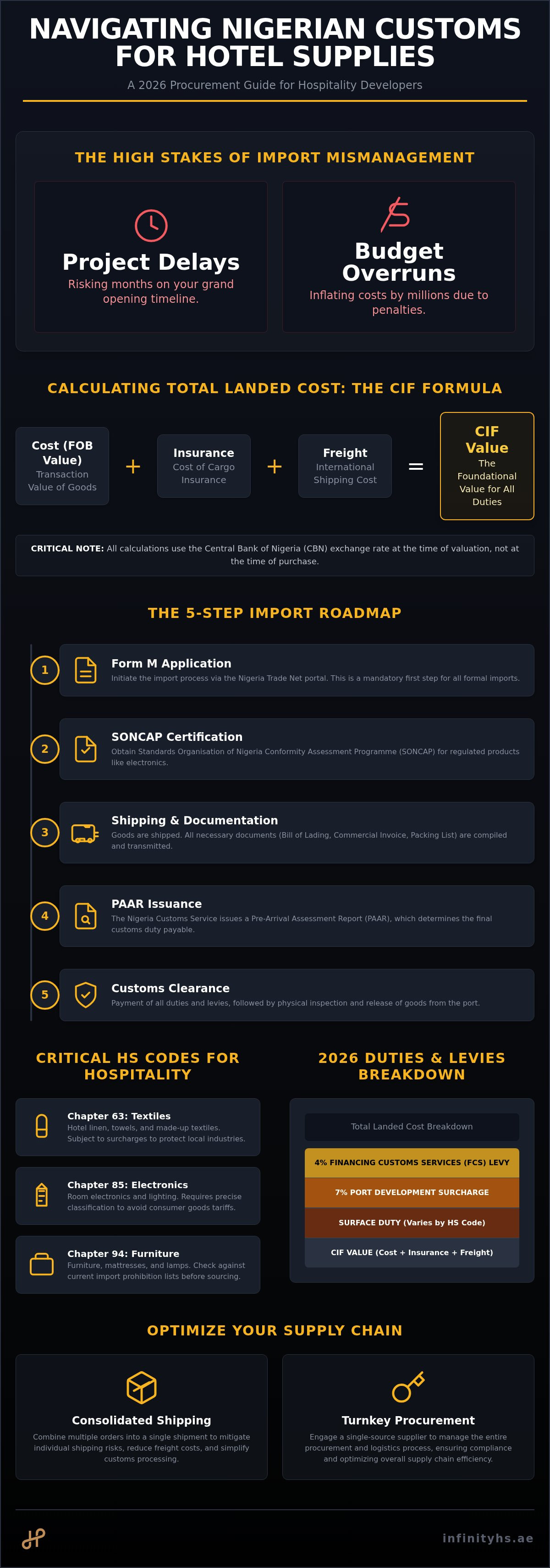
Classification accuracy begins with identifying the correct chapters within the CET. For the hospitality sector, three chapters are particularly critical for your procurement planning:
- Chapter 63: This includes hotel linen, towels, and other made-up textiles. These items are often subject to specific surcharges to protect local textile industries, making precise classification vital for budget accuracy.
- Chapter 85: This covers room electronics, lighting fixtures, and telecommunications equipment. Given the technical nature of these goods, precise sub-classification is required to distinguish professional hotel equipment from standard consumer electronics.
- Chapter 94: The foundation of any FF&E project, this chapter covers furniture, mattresses, and lamps. It's essential to verify if any specific furniture categories fall under the current import prohibition list before finalizing your global sourcing.
The 2026 Regulatory Environment in Nigeria
The current landscape is defined by the Customs, Excise Tariff, Etc. (Variation) Order, which became effective on May 1, 2026. This order revised duties on approximately 192 product categories to align more closely with regional trade goals. While Nigeria continues to integrate with the African Continental Free Trade Area (AfCFTA), the immediate practicalities of import remain complex. Engaging a licensed Customs Broker is no longer optional for large-scale developments; it's a necessity for navigating the 7% surcharge and the 4% Financing Customs Services (FCS) levy. These experts ensure that your project benefits from any available duty reductions while maintaining full compliance with the evolving 2026 fiscal policies.
Calculating the Total Landed Cost: The CIF Formula
Precision in procurement involves more than just selecting high-end products; it requires an exact understanding of landed costs to maintain project viability. The Nigeria Customs Service calculates duties based on the CIF value rather than the purchase price alone. The CIF value is the sum of the transaction value, international freight, and insurance costs. This figure serves as the foundational benchmark for all subsequent tax applications. When determining how to manage import duties for hotel supplies in Nigeria, you must also monitor the Central Bank of Nigeria (CBN) exchange rates. These rates are applied at the point of valuation, meaning a shift in currency value between the time of order and the time of arrival can significantly alter your final liability.
Once the CIF value is established in Naira, the Surface Duty is calculated based on the specific percentage assigned to your goods' HS code. This is where the Import Tariffs Guide becomes an indispensable resource for hospitality developers. Accuracy at this stage is non-negotiable. Overvaluation leads to unnecessary capital expenditure, while undervaluation can trigger severe penalties or lengthy port delays that disrupt your installation schedule.
Mandatory Levies and Additional Charges
Beyond the standard Surface Duty, several mandatory levies are applied to every shipment of hospitality goods. In 2026, the fiscal landscape includes specific charges designed to fund trade infrastructure and regional cooperation. These include:
- Financing Customs Services (FCS): A levy of 4% of the Free on Board (FOB) value.
- Comprehensive Import Supervision Scheme (CISS): A charge of 1% of the FOB value for inspection services.
- ECOWAS Trade Liberalisation Scheme (ETLS): A 0.5% levy of the FOB value, supporting regional trade integration.
- Surcharge: A 7% additional tax applied specifically to the calculated Import Duty amount.
VAT and Sector-Specific Taxes
The final layer of the calculation involves the Value Added Tax (VAT), which is currently set at 7.5%. This tax is not calculated on the CIF value alone; it is applied to the sum of the CIF, the Import Duty, and all applicable levies. This compounding effect means that high-value FF&E items can quickly accumulate significant tax overheads. For luxury developments, it is also wise to account for potential excise duties or luxury taxes that may apply to specific high-end furniture or specialized electronics. Investing in sourcing durable hotel linens and quality assets ensures that the intrinsic value of your goods justifies these necessary import costs. If you are planning a large-scale rollout, our consultants can help you estimate your total landed costs with professional precision.
Compliance Requirements for Hotel-Specific Goods
Compliance documentation serves as the structural foundation of a successful procurement project. While duty payments are financial, compliance is legal; without the correct certifications, the Nigeria Customs Service cannot release your shipment regardless of your payment status. Following the Official Nigerian Customs Regulations is essential to avoid the seizure of high-value assets or the imposition of heavy fines. For hospitality operators, this involves navigating two primary regulatory bodies: the Standards Organization of Nigeria (SON) and the National Agency for Food and Drug Administration and Control (NAFDAC). Mastering these regulatory hurdles is a core component of how to manage import duties for hotel supplies in Nigeria, as missing certifications often lead to punitive storage charges that erode your project's profitability.
Electronics and Technical Equipment Safety
Every electronic item, from guest room kettles to professional displays, falls under the Standard Organization of Nigeria Conformity Assessment Program (SONCAP). This program ensures that imported goods meet specific Nigerian Industrial Standards (NIS) to protect consumers. When importing Premium room electronics such as LOVO appliances, you must navigate a rigorous three-stage process. This begins with obtaining a Product Certificate (PC) for the specific item type, followed by a Certificate of Conformity (CoC), and finally the shipment-specific SONCAP Certificate (SC). Ensuring these documents are active before the vessel departs is critical for a smooth transition through customs. Additionally, sophisticated operators coordinate with suppliers to manage warranties within the Nigerian market, ensuring that technical support remains available locally for specialized hospitality equipment after the installation is complete.
Guest Amenities and Chemical Compliance
Guest-facing consumables require a different layer of scrutiny. NAFDAC regulates all imported soaps, shampoos, and lotions to protect public health and safety. For sustainable luxury brands like LUFTER PHYTOGREEN amenities, compliance involves verifying that all ingredients meet Nigerian safety standards. Labeling requirements for the Nigerian market are equally strict; every item must clearly state its ingredients, manufacturing date, and expiry date in English. If your project includes restricted hospitality chemicals, such as specialized cleaning agents for industrial housekeeping, you must provide Material Safety Data Sheets (MSDS). These documents prove the products are handled and stored according to international safety protocols, preventing costly delays during the Pre-Arrival Assessment Report (PAAR) verification phase at the port of entry.
The Import Procedure: A Step-by-Step Roadmap
The roadmap to a successful hotel launch in Nigeria is paved with meticulous documentation. While previous sections detailed the financial calculations and regulatory certifications, the actual import procedure requires a disciplined, sequential approach. Efficiency at this stage is the only way to prevent your capital from being tied up in port-side disputes. Understanding how to manage import duties for hotel supplies in Nigeria involves mastering the Nigeria Trade Net portal, which serves as the digital gateway for all commercial entries. A delay in any single step, from the initial application to the final physical inspection, can trigger a cascade of logistical setbacks.
Form M and Financial Documentation
Opening a Form M is your first digital milestone. This mandatory document, issued by the Central Bank of Nigeria through your authorized dealer bank, signals your intent to import goods. You must upload a detailed Proforma Invoice, a valid Insurance Certificate, and all necessary regulatory permits such as your SONCAP Product Certificate. Accuracy is paramount here; any discrepancy between the Form M and the final shipping documents will lead to a rejection by the Nigeria Customs Service. Form M for non-capital goods typically remains valid for 180 days. You must monitor this window closely to avoid expiration, which would require a complete re-application and potentially stall your entire procurement timeline. Professional oversight during this phase is vital for managing freight for hotel supplies to Africa successfully.
Port Clearance and Logistics Strategy
Once your cargo is in transit, the focus shifts to securing the Pre-Arrival Assessment Report (PAAR). This document is issued by the Nigeria Customs Service Headquarters and serves as the final word on your duty valuation. The PAAR is generated based on the information provided in your Form M and the final Final Invoice. It determines the exact amount you must pay before the cargo arrives. Upon arrival at ports like Lagos or Port Harcourt, your goods will undergo a physical inspection or a document audit, depending on the "lane" assigned to your shipment. Choosing the right logistics strategy is essential for building a resilient hotel supply chain in Africa. While sea freight is standard for heavy FF&E, air freight is often the superior choice for high-value OS&E categories to minimize the risk of demurrage and detention charges.
Demurrage, the fee charged by terminal operators for late container pickup, can quickly exceed the value of the goods themselves. To avoid these costs, ensure your Customs Broker is ready to commence the clearance process immediately upon the vessel's arrival. Utilizing inland container depots or newer facilities like the Lekki Deep Sea Port can also help you bypass the historical congestion of traditional hubs, ensuring your furniture and electronics reach your property on schedule.
Optimizing Your Nigeria Supply Chain with Infinity Hotel Supplies
Success in the Nigerian hospitality market requires more than just technical knowledge of customs; it demands a strategic approach to the entire supply chain. While individual shipments of furniture or electronics may seem manageable, the cumulative administrative burden of multiple Form M applications and PAAR assessments often leads to budget overruns. When hospitality operators evaluate how to manage import duties for hotel supplies in Nigeria, they often overlook the impact of shipment frequency on total administrative costs. Complexity demands a partner. Our global operational footprint across the UAE, China, and the UK allows us to perform rigorous quality control before any asset reaches Nigerian shores.
Consolidated shipping for FF&E and OS&E serves as a powerful tool for cost optimization. By grouping various product categories into fewer, larger shipments, we reduce the number of individual inspections and lower the total cost of levies like the CISS and ETLS. Our experience with West African luxury properties demonstrates that pre-shipment quality control in our China and UK offices eliminates the risk of port-side rejection. This meticulous attention to detail ensures that every item, from custom furniture to specialized room electronics, arrives in Lagos or Port Harcourt with the correct certifications already in place.
The Turnkey Advantage for New Hotel Builds
Managing a comprehensive OS&E list is a monumental task for any development team. Partnering with a single UAE-based entity like Infinity Hotel Supplies simplifies this process by providing a central point of accountability for global sourcing. We specialize in value engineering, a process that helps developers meet Nigerian budget constraints without sacrificing the brand standards that guests expect. This holistic approach is a core element of modern hospitality procurement solutions. We act as your seasoned global partner, navigating the finer details of logistics so your team can focus on the guest experience. By managing the entire procurement cycle, we mitigate the risks of delayed openings and ensure that your property is fully equipped for its first guest.
Long-Term Operational Support
The relationship does not end once the hotel doors open. Maintaining a five-star standard requires predictable restocking cycles for high-turnover items like linens and guest amenities. We provide continuous support by offering expert guidance on evolving Nigerian trade regulations and ensuring that your replenishment orders are handled with the same precision as your initial build. This steady, business-like composure prioritizes long-term collaboration over simple transactions. Our team remains a reliable ally, helping you adjust your procurement strategy as fiscal policies shift throughout 2026 and beyond.
Contact Infinity Hotel Supplies for a tailored Nigerian procurement strategy.
Securing Your Competitive Edge in the Nigerian Hospitality Market
The 2026 customs landscape in Nigeria offers significant opportunities for developers who approach procurement with technical rigor. Success depends on two pillars: precise classification using the latest HS codes and a proactive compliance strategy that addresses SONCAP and NAFDAC requirements well before your cargo arrives. By mastering the CIF formula and documentation sequence, you transform a complex logistical hurdle into a predictable part of your project timeline.
Learning how to manage import duties for hotel supplies in Nigeria is ultimately about risk mitigation. With over 10 years of global hospitality experience and dedicated offices in the UAE, China, and the UK, our team provides the stability needed for large-scale African developments. We manage the finer details of quality control and specialized regional logistics so you can focus on delivering an exceptional guest experience. Our specialized expertise ensures your FF&E and OS&E solutions are delivered with precision and established reliability.
Streamline your Nigerian hotel procurement with our expert turnkey solutions.
Your vision for a world-class property deserves a supply chain that is as meticulous and refined as the brand you're building.
Frequently Asked Questions
What is the current VAT rate for imported hotel supplies in Nigeria?
The current VAT rate for imported hotel supplies in Nigeria is 7.5%. This tax is not calculated on the purchase price alone; it is applied to the aggregate sum of the CIF value, the import duty, and all applicable levies. It is essential to factor this compounding effect into your landed cost calculations early. Accurate budgeting for VAT ensures that your project remains financially viable as you learn how to manage import duties for hotel supplies in Nigeria.
Do I need a local partner in Nigeria to clear hotel furniture through customs?
You must engage a licensed Customs Broker to facilitate the clearance of hotel furniture and other FF&E assets. While you don't necessarily need a local business partner, the Nigeria Customs Service only processes clearances through authorized agents. These professionals possess the technical expertise to manage the Nigeria Trade Net portal and resolve port-side disputes. Working with an established global supplier further streamlines this process by ensuring all pre-shipment documentation is flawless and ready for brokerage.
What happens if I use the wrong HS code for my hotel linens?
Using an incorrect HS code for hotel linens can result in severe financial penalties or the seizure of your shipment. At a minimum, it leads to lengthy delays as Customs reassesses the goods, often applying the highest possible tariff rate or protective surcharges. This error can also trigger a query on your Pre-Arrival Assessment Report (PAAR), stalling your entire installation schedule. Precision in classification is the most effective way to protect your investment and maintain your project timeline.
How long does the customs clearance process typically take in Lagos ports?
The customs clearance process in Lagos ports typically takes between 7 to 14 days, provided all documentation is accurate and duties are paid promptly. However, this timeline can fluctuate based on port congestion, the specific lane assigned to your cargo, and the speed of physical inspections. To minimize this duration, ensure your Form M and PAAR are secured well before the vessel berths. Efficient logistics management is a key part of how to manage import duties for hotel supplies in Nigeria.
Is it possible to get duty waivers for new hotel development projects in Nigeria?
Duty waivers for new hotel developments are not guaranteed but may be available through specific government investment incentives or regional trade agreements like AfCFTA. The Nigerian government occasionally offers fiscal concessions for strategic infrastructure projects that promote tourism. You should consult with the Nigerian Investment Promotion Commission (NIPC) to verify if your specific project qualifies for Pioneer Status or other tax holidays. These incentives can significantly reduce the total landed cost of your FF&E and OS&E solutions.
What is the difference between SONCAP and NAFDAC for hotel amenities?
SONCAP and NAFDAC serve distinct regulatory purposes based on the nature of the goods. SONCAP is mandatory for hard goods and technical equipment, such as LOVO electronics and housekeeping trolleys, ensuring they meet Nigerian Industrial Standards. In contrast, NAFDAC regulates guest amenities and consumables, including LUFTER PHYTOGREEN soaps and lotions. Both require specific certificates that must be obtained before shipping to avoid immediate rejection at the port of entry and subsequent storage charges.
Can I import used hotel furniture into Nigeria in 2026?
Importing used hotel furniture into Nigeria is generally discouraged and often restricted under the current import prohibition list. The Nigerian government prioritizes the protection of local industries and the maintenance of high standards for the hospitality sector. Even if not explicitly banned, used items often face higher scrutiny and more complex valuation processes, which can lead to unpredictable duty assessments. For luxury properties, sourcing new, compliant FF&E assets remains the most reliable strategy for ensuring seamless operations and long-term durability.
How do I calculate the CISS levy for my hotel electronics order?
The Comprehensive Import Supervision Scheme (CISS) levy is calculated as 1% of the Free on Board (FOB) value of your hotel electronics order. Unlike the surface duty which is based on the CIF value, the CISS is strictly tied to the cost of the goods at the point of origin before insurance and freight are added. This levy is a mandatory payment intended to fund the administrative costs of the pre-importation inspection and monitoring services required by the Federal Government of Nigeria.

Article by
Infinity Editorial Team
With deep expertise in hospitality product FF&E and OS&E across the Middle East and Africa, Infinity Editorial Team brings insights from Infinity Hotel Supplies, helping developers, hoteliers, and homeowners transform spaces from empty shells to fully furnished, design-ready environments.
Disclaimer
The content published by Infinity Editorial Team is intended for informational purposes only. All articles, guides, and insights are based on industry knowledge and experience in hospitality FF&E and OS&E supply across the Middle East and Africa. Infinity Hotel Supplies does not guarantee specific outcomes and recommends consulting a qualified professional for project-specific requirements.


