
The highest thread count in your linen closet might be your property's most expensive mistake. While the marketing allure of a 1000-TC label is strong, these dense weaves often trap heat and succumb quickly to the aggressive laundry chemicals common in GCC facilities. For procurement heads managing the Middle East's record 717 active hotel projects, the priority has shifted from chasing numbers to mastering fiber integrity. This hotel linen thread count guide for luxury properties provides the technical framework you need to navigate the 2026 market with precision.
It's frustrating when guest complaints about scratchy sheets persist despite significant investment in premium textiles. We understand that balancing immediate comfort with a 400-wash cycle lifespan is a complex calculation of staple length and weave density. This guide promises to bridge that gap. You'll learn to achieve consistent 5-star sleep quality while reducing replacement frequency. We examine the impact of new GOTS 8.0 standards, the shift toward GSM as a quality indicator, and the specific procurement strategies that ensure a clear ROI for your luxury rooms.
Key Takeaways
- Learn why thread count serves as a secondary metric compared to fiber staple length when aiming for a lifespan exceeding 400 wash cycles.
- This hotel linen thread count guide for luxury properties clarifies how to select high-performance weaves that resist pilling and graying in industrial laundries.
- Evaluate the performance differences between 300TC and 600TC linens through Dubai-based case studies focused on hand-feel and durability.
- Understand how to mitigate the specific effects of GCC-related factors, such as desalinated water and high-heat drying, on your textile inventory.
- Discover how to optimize your linen lifecycle by implementing rigorous quality control and precise PAR level management for new property openings.
Beyond the Numbers: Defining Thread Count for High-Turnover Luxury Hospitality
Precision procurement begins with a technical understanding of what thread count means in a B2B context. It's the total number of warp (vertical) and weft (horizontal) threads woven into one square inch of fabric. While retail consumers often use this number as a shorthand for quality, luxury hotel operators must view it as a metric of density and breathability. A higher number isn't always better. In high-turnover environments, excessive density can trap heat and resist the deep cleaning required for hygiene standards.
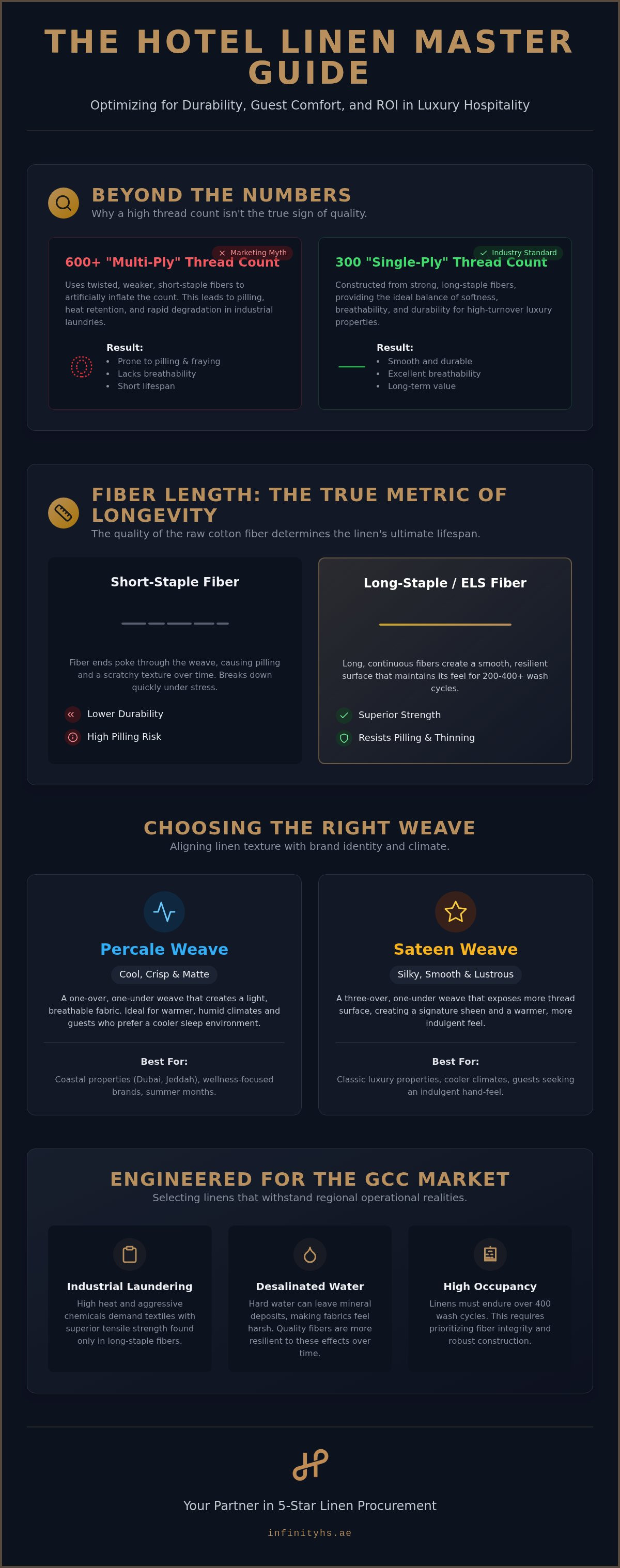
The "1000 Thread Count" marketing myth often collapses under the pressure of industrial laundering. These ultra-high counts usually rely on multi-ply yarns, which creates a thick, heavy sheet that lacks the crispness guests expect. For 5-star properties in the GCC, the industry standard remains a 300 to 400 thread count. This range provides the ideal balance of tactile softness and structural integrity. 4-star properties frequently opt for 200 to 300 thread count linens, which offer faster drying times and lower operational costs without sacrificing the professional aesthetic.
The Thread Count vs. Quality Paradox
Multi-ply yarns are the primary tool used to artificially inflate thread count. Manufacturers twist two or three thin, lower-grade fibers together to count them as multiple threads. This practice doesn't improve the sheet's longevity. It actually increases the likelihood of pilling and fraying. This hotel linen thread count guide for luxury properties emphasizes that a 300TC single-ply sheet consistently outperforms a 600TC multi-ply alternative. Single-ply construction uses long, strong fibers that maintain their "hand-feel" even after 100 wash cycles.
Identifying "marketing thread count" during the procurement phase requires a meticulous review of technical specifications. Always request the yarn type and ply count alongside the thread count. If a supplier offers an exceptionally high thread count at a suspiciously low price point, they're likely using multi-ply short-staple cotton. These sheets will gray and thin rapidly when exposed to the high-heat drying cycles necessary in large-scale hospitality operations.
Guest Expectations in 2026 Luxury Properties
Guest preferences are shifting toward minimalist luxury and wellness-oriented textures. While sateen weaves remain popular for their silky sheen and warmth, many high-end boutique hotels now favor percale. Percale offers a "matte" finish and a cool, crisp feel that resonates with travelers seeking a breathable sleep environment. Your choice between these two weaves should align with your brand identity and the local climate. Sateen feels indulgent in cooler months, while percale is a strategic choice for the humid coastal environments of Dubai and Jeddah. Explore our luxury hotel linen collections to see how different weaves and counts impact the guest experience.
The Science of Durability: Why Fiber Length Outranks Thread Count
High-turnover luxury properties require textiles that survive the mechanical aggression of industrial ironers without losing their structural integrity. While density is often the focus of procurement, tensile strength is the true metric of a sheet's lifespan. This strength is derived not from the number of threads, but from the quality of the raw cotton. Long-staple and extra-long-staple (ELS) fibers allow for the spinning of thinner, stronger yarns that resist the thinning and fraying common in high-occupancy resorts. A Cornell University study on premium bedding underscores how these high-quality textiles directly influence guest satisfaction and property ratings. This hotel linen thread count guide for luxury properties prioritizes fiber integrity as the foundation of any sustainable procurement strategy.
Short-staple fibers are prone to pilling because the many "ends" of the short fibers eventually poke through the weave and tangle. In contrast, ELS cotton creates a smooth, continuous surface that maintains its hand-feel after 100 or even 200 wash cycles. Staple length is the primary indicator of linen longevity, representing the physical length of the individual cotton fibers used to spin the yarn. By investing in superior fibers, operators reduce the frequency of linen replacement, ensuring a better long-term ROI despite higher initial costs.
Material Composition and Laundering Resilience
The choice between 100% cotton and Chief Value Cotton (CVC) blends often depends on a property's specific laundry infrastructure. 100% cotton remains the gold standard for pure luxury, offering unparalleled breathability and a natural feel. However, CVC blends, which typically incorporate a polyester core, provide enhanced dimensional stability and significantly shorter drying times. This polyester reinforcement acts as a scaffold, preventing the cotton fibers from breaking down under the high-heat conditions typical of GCC laundry facilities. For resorts with high occupancy rates, these blends can extend the linen lifecycle while maintaining a 5-star aesthetic.
Weave Integrity and Dimensional Stability
Durability also depends on how the weave handles the stress of commercial dryers. A tight, consistent weave prevents excessive shrinkage and ensures that hems and seams remain intact during daily turnover. High-turnover environments demand reinforced stitching to prevent the fraying that often triggers premature linen retirement. Maintaining these standards requires precise stock management; you can learn more in our Strategic guide to hotel linen PAR levels. If you're currently evaluating textile specifications for a new property opening, reach out to our technical team for a detailed material analysis.
Performance Analysis: 300TC vs. 600TC in High-Occupancy Luxury Suites
Selecting the ideal specification requires more than just a preference for softness; it demands a rigorous analysis of operational performance. In this hotel linen thread count guide for luxury properties, we compare two distinct 5-star models in Dubai. Property A, a high-occupancy business hotel in Downtown, utilizes 300TC percale. Property B, an ultra-luxury resort on the Palm, opts for 600TC sateen. After 50 industrial wash cycles, Property A's linens maintained a consistent crispness, while Property B's sheets showed slight thinning at the seams, despite the higher initial density.
This performance gap often stems from the misconception that density equals durability. In reality, lower thread counts often provide superior breathability and better structural integrity according to Consumer Reports' tests. Visual whiteness also remained more stable in the 300TC model, as the looser weave allowed for more effective soil release during the wash cycle. Over an 18-month period, the total cost of ownership for the 300TC linens was lower due to reduced replacement rates and energy savings, whereas the 600TC inventory required more frequent spot treatments to maintain its premium opacity.
The 300TC Efficiency Model
The 300TC Efficiency Model excels in environments where operational speed is paramount. Because the fabric is less dense, it requires significantly less time in the dryer, reducing energy consumption in large-scale laundries. Business travelers frequently report a preference for the 'crisp' hand-feel of 300TC percale, which mimics the fresh sensation of a newly made bed better than dense, heat-trapping fabrics. This weave allows for maximum airflow, ensuring guests remain cool even in the desert climate of the GCC.
The 600TC Ultra-Luxury Standard
The 600TC Ultra-Luxury Standard is reserved for presidential suites and premium villas where guest expectations for opulence are absolute. These sateen linens offer a lustrous finish and a substantial weight that signals exclusivity. Managing these fabrics requires specialized laundering protocols to prevent the graying that occurs when detergents aren't fully rinsed from dense fibers. While 300TC linens offer a superior ROI for high-turnover standard rooms, 600TC remains a vital investment for low-occupancy suites where the guest's perceived value of silk-like comfort justifies the higher maintenance costs.
Strategic Sourcing for the Middle East: Laundering, Climate, and Longevity
Procurement in the GCC presents environmental challenges that standard global guides often overlook. Desalinated water, characterized by its unique mineral profile, interacts aggressively with textile fibers during the wash cycle. When combined with the high-heat drying protocols necessary for rapid turnover, these factors can accelerate the degradation of low-quality yarns. This hotel linen thread count guide for luxury properties recommends selecting specifications that account for these thermal and chemical stressors to maintain a pristine white finish over the long term.
In humid coastal regions like Dubai and Jeddah, linens are susceptible to yellowing caused by atmospheric oxidation and residual laundry chemicals. Strategic sourcing involves selecting fabrics treated with optical brighteners that remain stable under GCC conditions. For remote luxury resorts in Africa, logistics and warehousing become critical components of the procurement strategy. Managing lead times requires a partner who understands the regional supply chain and can maintain buffer stocks to prevent inventory shortages during peak seasons.
Optimizing for Industrial Laundry Cycles
Efficient chemical penetration is vital for maintaining hygiene and brightness in high-volume operations. If a thread count is too high, the dense weave can prevent detergents and conditioners from reaching the core of the yarn, leading to a "graying" effect over time. Calendaring, a process where fabric is pressed between high-pressure heated rollers, is essential for GCC hotels. This finish provides the smooth, reflective surface guests associate with luxury without requiring an excessively high thread count that would impede the laundering process. For more detailed insights, see our guide on Sourcing premium hotel linens in the UAE.
Sustainability and Ethical Sourcing in 2026
The Middle Eastern hospitality sector is rapidly adopting green mandates, with the Dubai Sustainable Tourism Stamp seeing a 55% increase in awarded hotels in 2026. In Riyadh, there is a distinct shift toward organic cotton and GOTS certification as properties align with Vision 2030 sustainability goals. Balancing these eco-friendly initiatives with the need for high-frequency industrial laundering requires meticulous material selection. Organic fibers must possess the same tensile strength as conventional cotton to survive the 300+ wash cycles expected of 5-star inventory. You can also explore our Sourcing custom hotel amenities in Riyadh guide for a holistic view of regional procurement trends.
Optimizing Your Linen Lifecycle with Infinity Hotel Supplies
Infinity Hotel Supplies operates as a meticulous facilitator of high-end experiences, moving beyond simple transactions to provide comprehensive logistical support. Since our founding in 2014, we've established global offices in the UAE, China, and the UK to manage the intricate quality control required for premium textiles. This global footprint allows us to oversee the manufacturing process at the source, ensuring that the fiber specifications discussed in this hotel linen thread count guide for luxury properties are strictly maintained from the loom to the laundry room. We don't just supply products; we secure your property's reputation for excellence.
For developers and operators managing the Middle East's record 717 active hotel projects, we offer turnkey procurement expertise that simplifies the path to opening. Our role begins long before the first guest arrives. We assist with thread count selection tailored to your property’s specific climate and brand identity, followed by precise PAR level setup to ensure operational stability. This end-to-end methodology minimizes the risk of inventory shortages and guarantees that every room meets the 5-star standards your guests expect. Our team manages every detail with the foresight required for large-scale hospitality solutions.
Beyond Linen: A Holistic OS&E Partner
Achieving a cohesive guest experience requires a unified approach to all room elements. We ensure that your linen quality integrates seamlessly with premium bathroom accessories, creating a tactile narrative of luxury throughout the suite. Consistency is equally vital for your front-of-house and back-of-house teams; we apply the same rigorous quality standards to hotel uniforms to ensure your staff reflects your property’s prestige. Our global sourcing offices allow us to consolidate these diverse needs into a single, managed supply chain, significantly reducing procurement risk for high-turnover hotels.
Take the Next Step in Your Procurement Strategy
The complexities of 2026 textile regulations, including the new GOTS 8.0 standards and SASO amendments, require a partner with deep technical knowledge. We invite you to request a technical consultation to review your property's current specifications or plan for upcoming builds. Our specialists provide detailed material analyses and bespoke weave options, ensuring your signature luxury property stands out in a competitive market. Access our 2026 OS&E catalog to explore the full breadth of our premium hospitality solutions.
Securing Operational Excellence in Luxury Hospitality Textiles
Mastering the technical specifications of your textile inventory is a prerequisite for maintaining guest satisfaction and operational ROI in 2026. This hotel linen thread count guide for luxury properties has highlighted that true quality is found in the integrity of long-staple fibers and the resilience of single-ply weaves. While high density may offer a lustrous finish, the practicalities of GCC laundering and climate demand a strategic balance between tactile softness and industrial durability. By prioritizing tensile strength and weave breathability, you ensure your property delivers a consistent 5-star sleep experience without the burden of frequent replacement costs.
Infinity Hotel Supplies serves as your steady, experienced partner in navigating these complex procurement challenges. Our global sourcing offices in the UAE, UK, and China ensure that every shipment meets the meticulous standards required for high-turnover 5-star properties. We provide turnkey OS&E solutions that translate technical specifications into seamless guest experiences, allowing your team to focus on service delivery. We look forward to facilitating your property's next level of excellence through precision sourcing and global expertise.
Frequently Asked Questions
What is the best thread count for 5-star hotel sheets in 2026?
The optimal range for 5-star properties remains 300 to 400 thread count. This specific density allows for a luxurious hand-feel while maintaining the breathability necessary for guest comfort. Selecting a single-ply construction within this range ensures the fabric survives the rigors of industrial laundering without losing its structural integrity. Higher counts often lead to heat retention and slower drying times in high-occupancy environments.
Does a higher thread count make hotel sheets more durable?
Thread count is not a direct indicator of durability. In fact, excessively high counts often rely on thin, multi-ply yarns that fray and pill quickly under mechanical stress. True longevity is derived from fiber staple length and tensile strength. A 300TC sheet made from long-staple cotton will consistently outlast a 600TC sheet made from inferior, short-staple fibers that break down after fewer wash cycles.
What is the difference between Percale and Sateen for luxury hotels?
Percale utilizes a one-over, one-under weave that produces a matte finish and a crisp, cool feel ideal for warm climates. Sateen uses a four-over, one-under structure, resulting in a lustrous sheen and a silk-like drape that feels warmer to the touch. Your choice should align with your brand identity; boutique hotels often prefer the clinical crispness of percale, while traditional luxury suites opt for sateen's opulence.
How many wash cycles should high-quality hotel linen last?
Premium 100% cotton bed sheets should survive 300 to 400 industrial wash cycles before showing signs of thinning or graying. In contrast, pillowcases typically average around 70 cycles due to higher direct contact and soil levels. Bath towels generally last for approximately 120 cycles. Maintaining a strict PAR level is essential to ensure linens have adequate "rest time" between these aggressive cleaning and drying processes.
Why do hotels in the Middle East prefer specific cotton blends?
Properties in the GCC often favor Chief Value Cotton (CVC) blends because they withstand the unique mineral profile of desalinated water. These blends incorporate a polyester core that provides superior dimensional stability, preventing the shrinkage and distortion common in 100% cotton fabrics. This material choice also reduces drying times in high-heat environments, which is a critical factor for maintaining operational efficiency during peak tourism seasons.
Can thread count affect the drying time and energy costs of a hotel?
Density directly impacts your utility overhead. High-thread-count fabrics are more tightly woven, meaning they retain more water during the extraction phase of the wash cycle. This results in longer drying times and increased energy consumption. By selecting a mid-range thread count, procurement managers can significantly reduce their property's carbon footprint and operational costs without compromising the tactile quality that luxury guests expect.
How do I spot fake high-thread-count sheets during procurement?
This hotel linen thread count guide for luxury properties recommends inspecting the yarn ply as your primary verification step. Manufacturers often twist three lower-grade threads together to claim a "triple" thread count, which results in a heavy, stiff fabric that lacks softness. If a sample feels unnaturally thick or lacks a natural drape, it's likely a multi-ply marketing gimmick rather than a genuine high-density weave.
What is the ideal thread count for high-turnover boutique properties?
Boutique hotels with high occupancy rates should focus on the 200 to 300 thread count range. These specifications offer the fastest turnaround times in the laundry while providing the crisp, professional aesthetic that modern travelers appreciate. This range is particularly effective for properties that prioritize a minimalist design, as the fabric maintains its shape and "whiteness" longer than more complex, high-density weaves that trap laundry chemicals.

Article by
Infinity Editorial Team
With deep expertise in hospitality product FF&E and OS&E across the Middle East and Africa, Infinity Editorial Team brings insights from Infinity Hotel Supplies, helping developers, hoteliers, and homeowners transform spaces from empty shells to fully furnished, design-ready environments.
Disclaimer
The content published by Infinity Editorial Team is intended for informational purposes only. All articles, guides, and insights are based on industry knowledge and experience in hospitality FF&E and OS&E supply across the Middle East and Africa. Infinity Hotel Supplies does not guarantee specific outcomes and recommends consulting a qualified professional for project-specific requirements.


