

Did you know that by October 17, 2026, all cosmetic products distributed in Indonesia must hold official Halal certification or face removal from the market? This looming deadline highlights a global shift where Sharia compliance is no longer a niche preference but a mandatory standard for international hospitality. For procurement directors, sourcing halal-certified hotel guest amenities has become a high-stakes task that demands more than just a cursory glance at an ingredient list. You likely recognize the growing pressure to satisfy the 245 million Muslim travelers projected to be crossing borders by 2030, yet the fear of a non-compliant product damaging your brand's reputation in the Middle East remains a significant concern.
It's frustrating when the distinction between "halal-friendly" and "halal-certified" isn't clear, especially when your hotel's integrity is on the line. This article promises to demystify the process, offering you a clear framework for auditing suppliers and verifying global supply chain transparency. We'll explore the essential 2026 procurement checklist, from understanding regional GSO 2055 standards to ensuring your luxury guest rooms reflect a seamless, authentic commitment to Halal excellence.
Key Takeaways
- Understand the critical shift from "halal-friendly" to mandatory certification, ensuring your procurement strategy meets the strict regulatory standards set for 2026.
- Learn to identify hidden non-compliant ingredients, such as animal-derived stearic acid and glycerin, to maintain the integrity of your guest toiletries.
- Implement a rigorous 5-point framework for sourcing halal-certified hotel guest amenities that prioritizes recognized international bodies and supply chain transparency.
- Establish a reliable verification process for global suppliers, including cross-referencing certificate validity and conducting third-party audits in non-Muslim majority regions.
- Discover how to seamlessly integrate pre-vetted, high-quality solutions like LUFTER PHYTOGREEN to meet the rising demand for Sharia-compliant luxury.
The Significance of Halal Standards in Modern Hospitality
Halal certification represents more than a label; it's a rigorous commitment to purity and ethical production. While many operators assume that simply being porcine-free is sufficient, true compliance involves understanding Halal principles that govern the entire supply chain. This includes everything from the extraction of raw materials to the prevention of cross-contamination with najis (impurities) during manufacturing. In the competitive landscape of Riyadh and Dubai, 5-star properties are finding that "Halal-friendly" claims often fall short of guest expectations. Sourcing halal-certified hotel guest amenities is now a prerequisite for maintaining high-end hospitality reputations, ensuring that every touchpoint in the guest room aligns with their values.
The growth of the Halal travel market is reshaping GCC brand standards. By 2026, international Muslim traveler arrivals are projected to grow significantly, reaching 245 million by 2030 according to industry forecasts. This volume of guests brings a sophisticated understanding of certification. They expect transparency. When a guest enters a luxury suite, the presence of verified amenities serves as a silent ambassador for the hotel's dedication to their comfort. This trust is the foundation of long-term loyalty in the high-end sector.
The Evolution of Muslim Travel Preferences
The modern "Gen M" traveler seeks a holistic experience where their lifestyle is respected without compromising on luxury. By 2026, this demographic will drive a significant portion of the Halal tourism market, which Future Market Insights estimates will reach $320.3 billion. Amenities play a vital role here. Guests don't just want a soap that's permissible; they want products that reflect a commitment to ethical and sustainable luxury. This shift means that amenities must be both Sharia-compliant and environmentally conscious. It's about bridging the gap between faith and modern values through meticulous product selection.
Regulatory Landscape in the GCC
The regulatory environment in the Gulf is becoming increasingly structured to protect consumers. Standards like the GSO 2055 series provide a clear framework for what constitutes a compliant personal care product. For massive developments like the NEOM project, adhering to these standards is non-negotiable to attract a global audience. Procurement teams must align their strategies with specialized hospitality procurement solutions to ensure every vendor meets these regional benchmarks. Effective sourcing halal-certified hotel guest amenities involves a deep dive into these regulations to avoid the reputational damage of non-compliance.
Ingredient Transparency: Auditing Guest Toiletries
While food and beverage often take center stage in compliance discussions, the chemical composition of toiletries requires an equally rigorous audit. Sourcing halal-certified hotel guest amenities involves scrutinizing derivatives that often hide behind complex scientific names. Stearic acid and glycerin, common in soaps and lotions, are frequently derived from animal fats. Unless these ingredients are explicitly certified as plant-based or sourced from Halal-slaughtered animals, they pose a significant risk to your brand's compliance status. In the luxury sector, guests deserve transparency. Assuming an ingredient is safe without verification is a gamble that procurement teams can't afford to take.
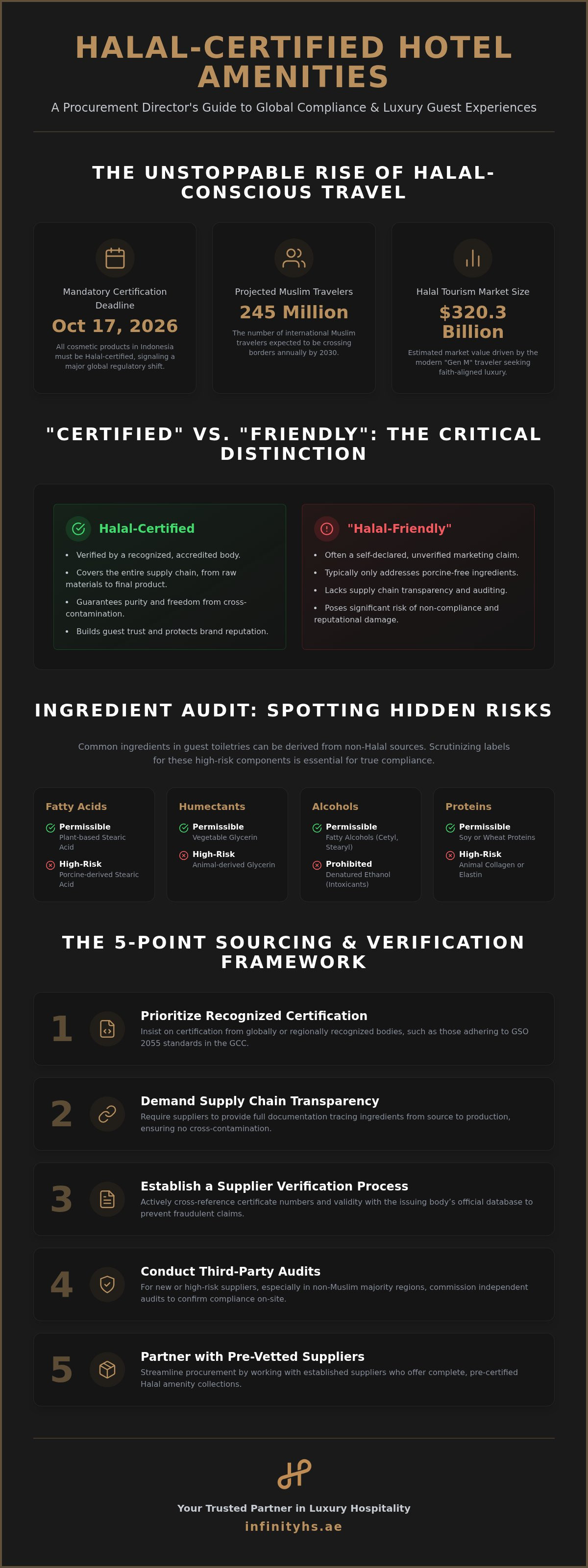
| Ingredient Category | Permissible Sources | Prohibited / High-Risk Sources |
|---|---|---|
| Fatty Acids | Plant-based Stearic Acid | Porcine-derived Stearic Acid |
| Humectants | Vegetable Glycerin | Animal-derived Glycerin |
| Alcohols | Cetyl or Stearyl Alcohol | Denatured Ethanol (Intoxicants) |
| Proteins | Soy or Wheat Proteins | Animal Collagen or Elastin |
Distinguishing between these categories requires technical expertise and adherence to recognized Halal certification standards. The "alcohol question" is a primary point of confusion for many operators. While denatured ethanol is avoided because of its association with intoxicating substances, fatty alcohols are permissible as they don't share the same properties. Effective sourcing halal-certified hotel guest amenities requires verifying that no non-compliant substances contact the product during batching, filling, or packaging phases. This level of scrutiny is essential for high-end properties aiming for absolute guest trust.
Common Red Flags in Ingredient Lists
Procurement teams should watch for chemical names that mask non-Halal sources. For example, tallowate or porcine-derived collagen are frequently found in mass-market soaps. While "Cruelty-Free" and "Vegan" labels are a helpful starting point, they aren't a final conclusion. A vegan product might still contain alcohol that doesn't meet specific Sharia requirements or be processed in a facility that handles non-Halal materials. Synthetic alternatives are increasingly becoming the gold standard for luxury amenities because they offer a verifiable, consistent path to compliance without the risks associated with animal byproducts.
Audit Checklist for Leather and Fabric Accessories
Compliance extends beyond the bathroom. When evaluating leather accessories such as desk blotters, remote holders, or tissue box covers, it's vital to ensure they're porcine-free. Pigskin is often used as a cost-effective lining in leather goods, which would render the item non-compliant in a Sharia-compliant setting. Similarly, dyes and finishing agents must be audited for animal-derived stabilizers or fats. Integrating these requirements with sustainable hotel supplies ensures your property meets both ethical and religious expectations. For a detailed consultation on compliant OS&E, partnering with an experienced supplier can simplify this complex verification process.
The 5-Point Sourcing Checklist for Halal-Certified Amenities
Effective sourcing halal-certified hotel guest amenities requires a structured approach that moves beyond trust and into verification. As global standards tighten for 2026, relying on a simple logo is no longer enough for high-end properties. This 5-point checklist ensures your OS&E selections meet the highest Sharia-compliant standards while maintaining the luxury your guests expect. By following these steps, you can mitigate the risk of non-compliance and protect your brand's reputation in sensitive markets.
- Verify Certification Authenticity: Confirm that the certifying body is recognized by regional authorities such as the GSO in the Gulf or BPJPH in Indonesia.
- Supply Chain Mapping: Demand full transparency for all additives, including stabilizers, fragrances, and emulsifiers, tracing them back to the raw source.
- Manufacturing Facility Audit: Verify that production lines are either dedicated to Halal products or undergo a validated cleaning protocol to prevent cross-contamination.
- Labeling and Branding Compliance: Ensure that the representation of Halal status on your hotel amenities is accurate, legible, and legally sound.
- On-Site Documentation: Maintain a comprehensive "Halal Assurance System" (HAS) to provide ready proof of compliance during internal audits or brand inspections.
Point 1 & 2: Certification and Traceability
Understanding the specific Halal Certification Requirements for Cosmetics is the first step in spotting fraudulent or misleading logos on bulk orders. It's common to find certificates that have already expired or don't cover the specific SKU you're purchasing. You should ask suppliers about their Tier 2 and Tier 3 vendors to ensure that even the smallest raw material providers adhere to strict standards. This level of scrutiny is where the value of working with a global hotel procurement company becomes evident; they possess the resources to vet complex international supply chains that local teams might find inaccessible.
Point 3 & 4: Production and Presentation
Auditing the "Halal Integrity" of the packaging process is just as vital as the product inside the bottle. You must ensure that custom branding doesn't use prohibited animal-derived inks or adhesives that could compromise the product's status. When integrating Halal signage or subtle indicators into the bathroom accessories layout, clarity is key. The guest should feel confident in the product's compliance from the moment they see the packaging. This meticulous attention to detail prevents brand damage and reinforces your hotel's commitment to guest values, ensuring a seamless luxury experience.
Verifying Global Supply Chain Integrity
Verifying the integrity of a global supply chain requires a methodical approach that extends far beyond the factory floor. Sourcing halal-certified hotel guest amenities from international markets introduces layers of complexity, particularly regarding cross-border logistics and varying certification standards. To ensure absolute compliance, procurement officers must move through a rigorous verification sequence. This process begins with the manufacturer’s valid Halal certificate. You must cross-reference the expiry date with the issuing body's database, as forged or lapsed documents are a persistent issue in global trade.
The second step involves conducting a third-party audit or site visit if you're sourcing from non-Muslim majority regions. Paperwork alone cannot confirm that a facility maintains the necessary segregation in a non-compliant environment. Third, review the Material Safety Data Sheet (MSDS) for every SKU in the amenity kit. This document provides the chemical origins and CAS numbers for components like stabilizers and preservatives that might not appear on a standard marketing label. The final step involves implementing a "Halal Control Point" within your warehouse logistics. This acts as a physical and digital gate, ensuring that only verified batches are released for distribution to 5-star properties, preventing the co-mingling of compliant and non-compliant stock.
Sourcing from Non-Muslim Majority Markets
Managing quality control when sourcing halal-certified hotel guest amenities from China or the UK presents unique challenges. In these regions, the risk of accidental cross-contamination is higher because the broader industrial environment doesn't default to Sharia standards. This is where the importance of regional offices becomes clear. Having a local team on the ground allows for unannounced inspections and direct oversight of production runs. It's a reliable way to mitigate risks during international freight and warehousing, ensuring that the "Halal chain" remains unbroken from the point of origin to the guest room.
The Role of Technology in Verification
Modern digital procurement platforms are essential for tracking certification status in real-time. These systems can trigger alerts when a supplier's certificate is nearing expiry, preventing a lapse in compliance that could disrupt your operations. Looking toward 2026, blockchain technology and QR codes are becoming the standard for guest-facing transparency. By scanning a code on a bottle of lotion, a guest can instantly view the certification details, fostering a level of trust that traditional labeling cannot match. Future-proofing your supply chain for 2026 regulations, specifically the strict Halal Product Assurance Law in Indonesia, requires a proactive stance on data management and technological integration.
Elevating the Guest Experience with Infinity Hotel Supplies
Infinity Hotel Supplies stands as a meticulous facilitator of high-end hospitality experiences, bridging the gap between complex Sharia requirements and luxury guest expectations. Our approach to sourcing halal-certified hotel guest amenities relies on a decade of regional expertise and a global footprint that spans the UAE, China, and the UK. By leveraging our pre-vetted vendor networks, we eliminate the ambiguity often associated with international procurement, providing operators with the stability they need to maintain brand standards. Our turnkey OS&E packages are specifically designed to meet the unique demands of the Middle East and African hospitality sectors, where precision and reliability are non-negotiable. This global operational footprint allows us to manage every detail with care and foresight, ensuring a seamless transition from procurement to the guest room.
A key component of our offering is the LUFTER PHYTOGREEN line. This specialized collection represents the pinnacle of sustainable, Halal-compliant room solutions, ensuring that every botanical extract and active ingredient meets strict ethical and religious benchmarks. Beyond the product formulation, we provide custom branding solutions that respect Sharia principles, ensuring that even the inks and adhesives used in your packaging adhere to non-animal-derived standards. We don't just supply products; we facilitate a holistic guest journey that prioritizes trust and long-term collaboration. This holistic approach ensures that sourcing halal-certified hotel guest amenities becomes a strategic advantage rather than a logistical burden.
Strategic Partnership for New Openings
Managing the pre-opening phase of a 5-star property requires a visionary understanding of guest needs and a pragmatic execution of supply chain logistics. We specialize in value engineering your amenity selection, ensuring that certification isn't sacrificed for cost efficiency. Our team's successful deployment for 5-star resorts in Riyadh serves as a blueprint for how we manage large-scale, compliant OS&E deliveries under tight deadlines. We act as a steady, experienced hand, navigating the complex logistical challenges of new developments while maintaining a focus on absolute compliance and operational efficiency.
Comprehensive OS&E Solutions
Our commitment to Halal integrity extends far beyond the bathroom vanity. We provide a one-stop solution for maintaining brand standards across all guest touchpoints, including room electronics and high-quality linen. By consolidating your procurement through a single, authoritative partner, you ensure a holistic guest experience where every item, from the bed sheets to the IPTV system, reflects your property's dedication to excellence. This end-to-end methodology reduces the risk of non-compliance and simplifies the audit process for your team. We invite you to contact Infinity for a tailored Halal audit of your guest supplies, allowing us to identify and resolve any potential gaps in your current inventory.
Securing Your Brand's Future in Sharia-Compliant Luxury
Adhering to strict Halal standards is no longer a choice but a cornerstone of excellence for high-end properties in the GCC. Success in 2026 depends on transitioning from surface-level claims to a verifiable, certified supply chain. By implementing a rigorous audit of ingredients and manufacturing processes, you protect your brand's reputation and foster deep guest trust. Sourcing halal-certified hotel guest amenities requires a partner who understands the technical nuances of these regulations and the logistical demands of 5-star hospitality.
Infinity Hotel Supplies has served as a turnkey procurement expert since 2014, specializing in GCC brand standards. Our global sourcing offices in the UAE, China, and the UK provide the rigorous quality control necessary to navigate the complexities of international trade. We manage every detail with the foresight required to ensure your guest rooms meet the highest benchmarks of purity and luxury.
We're here to help you deliver an authentic and sophisticated guest experience that honors regional values with absolute precision.
Frequently Asked Questions
What is the difference between Halal and vegan hotel amenities?
Vegan products exclude animal-derived ingredients but may contain alcohol or be manufactured on shared lines with non-Halal substances. Halal certification covers the entire supply chain, including ethical processing, the absence of intoxicants like denatured ethanol, and strict prevention of cross-contamination. While many Halal products are vegan, vegan labels don't automatically guarantee Sharia compliance because they don't account for religious manufacturing protocols or specific ingredient origins.
Do hotel soaps and shampoos really need to be Halal-certified?
Certification is essential for luxury properties aiming to build absolute guest trust and comply with tightening regional regulations. In markets like Indonesia, all cosmetics must be certified by October 17, 2026. Sourcing halal-certified hotel guest amenities provides a verifiable guarantee that your toiletries are free from porcine derivatives and najis (impurities), meeting the expectations of the 245 million Muslim travelers projected globally by 2030.
Is alcohol permitted in Halal-certified perfumes and toiletries?
Only specific types of alcohol are permitted under strict Sharia standards. Denatured ethanol is generally prohibited because it's derived from the same sources as intoxicants. However, fatty alcohols like cetyl and stearyl alcohol are permissible because they occur naturally in plants and don't have intoxicating effects. Sourcing halal-certified hotel guest amenities requires a technical review of the Material Safety Data Sheet to distinguish between these chemical categories accurately.
How can I verify a Halal certificate from an international supplier?
You should cross-reference the certificate number with the issuing body's official database to confirm its validity and expiry date. It's vital to ensure the certifying organization is recognized by regional authorities like the GSO in the Gulf. For suppliers in non-Muslim majority regions like China or the UK, conducting a third-party audit or site visit adds a necessary layer of security to verify manufacturing segregation.
Are there specific packaging requirements for Halal amenities?
The integrity of the packaging is just as critical as the product itself. The inks and adhesives used for custom branding must be free from animal-derived stabilizers or fats to prevent contamination. Additionally, the packaging must clearly display recognized Halal logos to provide guest-facing transparency. This meticulous attention to detail ensures that the entire OS&E package remains compliant from the factory floor to the luxury guest room.
Why should Middle East hotels prioritize Halal-certified guest products in 2026?
Prioritizing certified products is a strategic move to align with the massive growth in Halal tourism, which Future Market Insights estimates will reach $320.3 billion by 2026. With major developments like NEOM setting new luxury benchmarks, guests expect holistic compliance that extends beyond food to personal care. Maintaining these standards protects your brand reputation and ensures you're prepared for the evolving regulatory frameworks across the GCC and Southeast Asia.
Can leather hotel accessories be non-Halal?
Leather items are non-compliant if they contain porcine derivatives or were processed with non-Halal animal fats. Pigskin is frequently used as a hidden lining in remote holders, desk blotters, and tissue boxes because it's cost-effective. To maintain Sharia compliance, procurement teams must verify that all leather accessories are sourced from permissible animals and finished with compliant dyes, ensuring the room's environment remains entirely pure for the guest.
What are the main prohibited ingredients in guest toiletries?
Prohibited ingredients include anything derived from pigs, such as porcine-based gelatin, and animals not slaughtered according to Sharia law. Hidden animal derivatives like stearic acid, tallowate, and glycerin are common red flags in mass-market soaps. Additionally, intoxicants like denatured ethanol are strictly excluded. Identifying these substances requires a deep dive into chemical origins, making it essential to partner with a supplier that maintains rigorous and transparent supply chain controls.

Article by
Infinity Editorial Team
With deep expertise in hospitality product FF&E and OS&E across the Middle East and Africa, Infinity Editorial Team brings insights from Infinity Hotel Supplies, helping developers, hoteliers, and homeowners transform spaces from empty shells to fully furnished, design-ready environments.
Disclaimer
The content published by Infinity Editorial Team is intended for informational purposes only. All articles, guides, and insights are based on industry knowledge and experience in hospitality FF&E and OS&E supply across the Middle East and Africa. Infinity Hotel Supplies does not guarantee specific outcomes and recommends consulting a qualified professional for project-specific requirements.


