

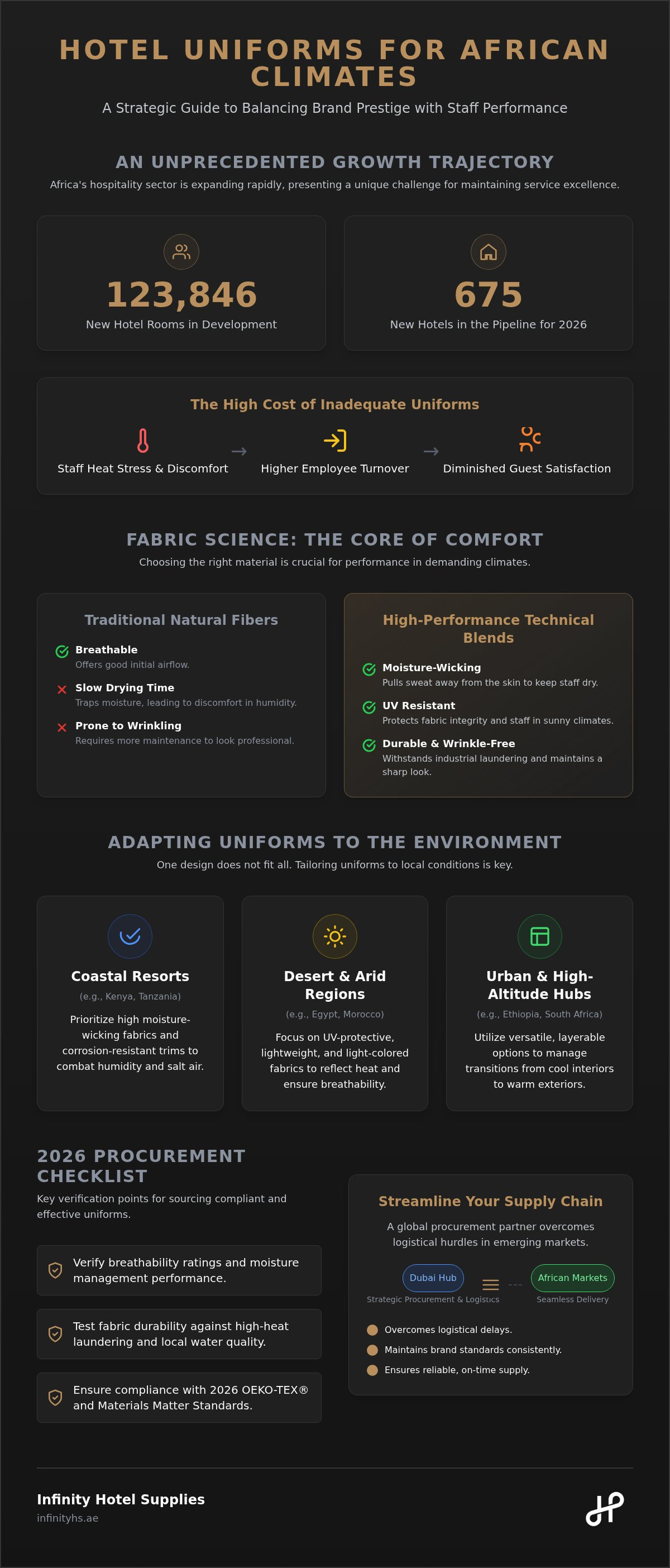
With Africa's hotel development pipeline reaching a record 123,846 rooms across 675 hotels in 2026, the scale of regional hospitality growth is truly unprecedented. You likely recognize that a uniform is far more than a simple dress code; it's a critical tool for both service excellence and staff retention. Finding a specialized hotel uniform supplier for African climates is essential when your team must perform in environments ranging from the humid coastlines of Kenya to the intense heat of Egypt. Staff discomfort shouldn't be the reason for high turnover or slipping service standards.
It's frustrating when high-end garments fade after a few washes or leave employees struggling in the heat. This guide provides the expertise you need to source uniforms that balance brand prestige with high-performance comfort. We'll examine the 2026 OEKO-TEX® textile regulations and the transition to the Materials Matter Standard to ensure your supply chain remains compliant and sustainable. From selecting breathable, UV-resistant fabrics to navigating logistical hurdles in emerging markets, we'll preview the strategies that keep your operations seamless and your brand identity sharp.
Key Takeaways
- Understand how climate-adaptive textiles regulate body temperature to reduce staff heat stress and maintain high guest satisfaction scores.
- Selecting a specialized hotel uniform supplier for African climates ensures access to high-tech moisture-wicking fabrics that outperform traditional natural fibers in humid zones.
- Learn to adapt uniform designs for specific environments, from managing salt-air corrosion in coastal resorts to handling temperature transitions in urban hubs.
- Utilize our 2026 technical checklist to verify breathability ratings and fabric durability against local water quality and high-heat laundering.
- Discover how a global procurement partner leverages strategic hubs like Dubai to overcome logistical delays and maintain brand standards across emerging African markets.
The Critical Role of Climate-Adaptive Uniforms in African Hospitality
Climate-adaptive uniforms represent a significant shift from traditional workwear to high-performance apparel. These garments utilize specialized textiles designed to regulate body temperature in extreme environments, ensuring staff remain cool and composed regardless of external heat levels. In many Sub-Saharan and tropical regions, standard corporate wear often fails because it relies on heavy polyesters or thick wool blends that trap heat against the skin. This leads to a rapid decline in employee energy and a visible loss of professional polish.
To better understand the intersection of design and utility, watch this helpful video regarding modern hospitality apparel:
Selecting a specialized hotel uniform supplier for African climates is no longer a luxury for 5-star properties; it's a operational necessity. When staff suffer from heat stress, their ability to maintain high guest satisfaction scores diminishes. A concierge or front-desk agent struggling with thermal discomfort cannot provide the seamless, attentive service that defines luxury hospitality. The challenge for modern operators lies in balancing rigid brand standards with the biological comfort of their teams.
Thermal Comfort and Staff Retention
Uncomfortable uniforms are a hidden driver of employee fatigue and high turnover rates. If a garment is restrictive or non-breathable, the physical toll of an eight-hour shift increases significantly. There is a profound psychological benefit to wearing breathable apparel; when employees feel physically comfortable, they project more confidence and warmth to guests. Thermal comfort is the primary KPI for African hotel staff apparel because it directly correlates with service longevity and daily productivity.
Brand Prestige vs. Practical Functionality
Maintaining a sophisticated aesthetic doesn't require the weight of traditional European-style suits. Modern procurement strategies allow hotels to keep a polished look by using lighter weaves and moisture-wicking linings. For inspiration, many designers are looking back at traditional African textiles that have used cotton and natural fibers for centuries to manage heat. Our specialized approach as a hotel uniform supplier for African climates ensures that front-office teams look sharp even in high-humidity coastal environments. For a broader look at how these choices fit into your hotel's opening or renovation, see our guide on Hospitality Procurement Solutions for strategic planning.
Fabric Science: Selecting Materials for Heat and Humidity
Selecting the right textile for a professional wardrobe is a precise science that balances aesthetic appeal with technical performance. While natural fibers like cotton and linen offer traditional breathability, they often struggle with wrinkling and slow drying times in high-pressure hospitality settings. Modern textile engineering has introduced high-tech synthetic blends that mimic the comfort of natural fibers while adding essential moisture-wicking capabilities. Research from the Georgia Institute of Technology indicates that the best fabrics for hot, humid conditions often include treated polyesters or specific weaves that promote rapid airflow. As a dedicated hotel uniform supplier for African climates, we prioritize materials that utilize capillary action to move perspiration away from the skin, a vital feature for staff working in humid tropical zones.
UV resistance is another critical factor often overlooked in standard procurement. In high-altitude regions like Ethiopia or desert climates like Egypt, intense sun exposure can degrade fabric fibers and cause rapid thinning of the material. We select fabrics with built-in UV protection to safeguard both the garment's integrity and the wearer's comfort during outdoor service. Furthermore, durability in industrial laundering is paramount. Many African regions contend with hard water, which can be abrasive to delicate textiles. Our uniforms are engineered to withstand mineral-heavy water and high-temperature drying without losing their structural shape or professional drape.
The Rise of Bamboo and Specialized Blends
Bamboo is gaining significant momentum in eco-friendly African resorts because of its natural breathability and exceptionally soft hand-feel. It's a sustainable choice that aligns with modern ESG goals. However, for high-traffic roles like housekeeping or maintenance, a polyester-cotton blend often provides the best balance of longevity and comfort. These blends resist pilling and maintain a crisp, professional appearance throughout a long shift. We also integrate anti-microbial treatments into the fabric finish to combat odor, which is a common challenge in tropical environments where humidity remains high year-round.
Colorfastness and UV Protection
Vibrant brand colors are essential for maintaining prestige, but they must be achieved through high-quality dyes that resist solar bleaching. The weight of the fabric, measured in GSM (Grams per Square Meter), must be carefully calibrated based on the specific staff role. Housekeeping teams require lower GSM fabrics for maximum heat dissipation, whereas front-office staff might need a slightly higher GSM to maintain a structured, formal silhouette. You can explore our Premium Hotel Linen to see how we maintain consistent textile quality across all guest-facing departments. Achieving this technical balance requires a partner who understands these regional environmental stressors. If you're looking to upgrade your staff's performance gear, reach out to our procurement specialists for a tailored consultation.
Regional Design Adaptation: Tailoring to African Environments
Africa's diverse geography requires a nuanced approach to uniform design that transcends basic aesthetics. A single design philosophy cannot serve a high-altitude boutique hotel in Addis Ababa and a beachfront resort in Zanzibar simultaneously. Each environment presents unique stressors that affect how a garment performs and how long it lasts. As an experienced hotel uniform supplier for African climates, we analyze regional humidity levels, solar intensity, and even local soil composition to recommend the most effective design configurations for your team.
Safari and Bush Lodge Aesthetics
For properties located in the bush, uniforms must be tactical yet refined. We prioritize earth tones like stone, khaki, and olive, which reflect the local landscape while effectively concealing the dust inherent in safari environments. Functionality is paramount in these active roles. We integrate reinforced stitching on stress points and add practical features like epaulettes for radios and deep, secure pockets for multi-tools. To maintain operational efficiency across your property, you should pair your uniforms with Housekeeping Trolleys designed for rugged resort terrain. This holistic approach ensures your staff and equipment are equally prepared for the demands of a wilderness setting.
Coastal and Island Resort Chic
Coastal environments present the dual challenge of extreme humidity and salt-air corrosion. Metal accessories like traditional brass buttons or standard zippers often fail quickly in these zones. We replace these with high-grade polymers or specially treated alloys that resist rust. To combat the "wet-look" caused by high perspiration, we utilize linen-look synthetics that offer the breezy aesthetic of the islands with superior wrinkle resistance. Understanding the properties of fabrics for hot conditions is essential here; open-weave structures allow for maximum airflow even when the air is stagnant. We also apply hydrophobic coatings to specific areas to prevent sweat stains from becoming visible during a shift.
Urban hubs like Nairobi, Lagos, and Luanda demand a different strategy focused on modularity. Staff in these cities often transition between air-conditioned interiors and the intense heat of the street. We design uniforms with layering in mind, providing lightweight blazers with mesh linings that can be removed during peak afternoon temperatures. This flexibility allows your team to maintain a polished, professional image without sacrificing their physical comfort. By focusing on these regional specifics, we help you build a wardrobe that is both a brand asset and a high-performance tool for your employees.
The 2026 Hotel Uniform Procurement Checklist
Success in large-scale hospitality procurement hinges on meticulous technical verification. As you evaluate a potential hotel uniform supplier for African climates, your checklist must extend beyond fabric swatches to include certified breathability ratings and moisture-wicking performance data. In 2026, the industry standard has shifted toward evidence-based textile selection to ensure staff can perform in the heat. A partner that understands these technical nuances is vital for maintaining brand prestige across diverse territories.
Local environmental factors like water hardness significantly impact garment longevity. You must test fabrics against the specific mineral content of your region's water supply and high-temperature industrial drying cycles. Additionally, maintaining a precise PAR level is non-negotiable for operational stability. We recommend a minimum ratio of 3:1 per staff member to account for daily wear, laundering time, and emergency replacements. For a deeper look at inventory logic, refer to our Hotel Linen PAR Level Guide.
Calculating Lifecycle and Replacement Cycles
Establishing a realistic budget requires looking at a 12-month wear-and-tear cycle rather than just the initial price point. The hidden expense of choosing low-quality alternatives is the high frequency of replacement, which eventually erodes your total ROI. A sophisticated procurement partner ensures scalability, guaranteeing that identical replacements remain available 12 to 24 months after the initial order. This foresight prevents the fragmented, inconsistent look that occurs when suppliers cannot replicate previous dye lots or fabric weights.
Supplier Vetting for African Projects
Effective logistics are the backbone of any African hospitality project. You need a partner with a proven track record of clearing customs in complex ports and managing established GCC-to-Africa trade routes. Quality control should happen at the source, utilizing third-party inspections in hubs like China or the UAE before the shipment ever reaches the water. Professional turnkey support provides the security and operational continuity required to manage complex supply chains in remote African markets.
Navigating African Logistics with Infinity Hotel Supplies
Sourcing high-performance apparel is a critical first step, but the true challenge for many operators lies in the final mile. Logistical delays at African ports or complex customs documentation can stall a property opening or leave a team undersupplied. As a specialized hotel uniform supplier for African climates, Infinity Hotel Supplies bridges the gap between global textile innovation and local operational reality. We leverage a sophisticated distribution network to ensure that your 5-star standards are maintained from the factory floor to your property gate.
Our global footprint includes established offices in the UAE, China, and the UK, which enables us to source the highest quality technical fabrics from the world's leading textile markets. This global reach is balanced by a commitment to meticulous quality control. Every garment undergoes a multi-stage inspection process before it ever reaches a shipping container. We verify stitching integrity, colorfastness against UV exposure, and specific GSM weights to ensure each item meets the rigorous demands of a 5-star hospitality environment. By managing the supply chain end-to-end, we remove the risk of receiving substandard goods in remote locations where returns are difficult.
The Advantage of a Dubai-Based Partner
Dubai serves as the strategic logistical gateway to the African continent, offering unparalleled connectivity to major ports in East and West Africa. We utilize our Dubai hub to consolidate shipments, reducing lead times and shipping costs for our partners. This central location allows for agile warehousing and faster response times when you need urgent replacements or seasonal updates. To understand how this fits into a larger strategy, you can learn about Global Hotel Procurement in 2026 and its impact on regional efficiency.
Turnkey Uniform Management
We offer a comprehensive turnkey methodology that seamlessly integrates your staff apparel into a broader OS&E procurement package. This holistic approach eliminates the need for multiple vendors and simplifies your project management by providing a single, authoritative point of contact. Our logistics specialists manage the intricate requirements of African customs documentation and stay updated on evolving regional import duties. This foresight prevents the costly delays often associated with international shipping to emerging markets.
This end-to-end service allows your executive team to focus on guest experiences while we handle the technical and logistical heavy lifting. Whether you are launching a new urban hub or a remote safari lodge, our expertise ensures your staff apparel is delivered on time and within budget. Contact Infinity Hotel Supplies for a custom uniform consultation today to secure your property's operational future.
Empowering Your Team Through Climate-Adaptive Apparel
Mastering the balance between brand prestige and staff comfort is essential for Africa's record-breaking hotel growth in 2026. You've seen how moisture-wicking fabrics and regional design adaptations prevent staff fatigue while elevating guest satisfaction scores. Selecting a specialized hotel uniform supplier for African climates ensures your property remains operational and your brand identity stays sharp across diverse borders. It's about transforming a standard requirement into a high-performance tool for your employees.
Infinity Hotel Supplies leverages deep-seated expertise in the GCC and African hospitality markets to deliver comprehensive turnkey OS&E and FF&E solutions. With global sourcing and meticulous quality control managed from our offices in the UAE, China, and the UK, we navigate the logistical heavy lifting so you don't have to. We're a seasoned global partner that values excellence and operational efficiency in equal measure.
Your team is the face of your hotel. Give them the high-performance apparel they need to succeed in any environment and watch your service standards soar.
Frequently Asked Questions
What is the best fabric for hotel uniforms in high-humidity African regions?
High-performance synthetic blends and treated polyesters are the most effective materials for humid zones. These textiles use capillary action to pull moisture away from the skin, promoting rapid evaporation and cooling. While natural fibers like cotton are breathable, they often retain moisture and lose their shape. We recommend fabrics that meet 2026 OEKO-TEX standards to ensure staff stay dry and comfortable during long shifts in tropical environments.
How many sets of uniforms should each hotel staff member have (PAR levels)?
We recommend a standard PAR level of 3:1 for every staff member. This ratio ensures one uniform is in active use, one is being laundered, and one remains in reserve for emergencies. Maintaining this inventory logic is crucial for operational stability, especially in properties where industrial laundering cycles are frequent. This approach prevents premature garment wear and ensures your team always presents a crisp, professional image to your guests.
Can you provide custom-branded uniforms for hotels in remote African locations?
Yes, we provide comprehensive turnkey solutions that include custom branding for properties in even the most remote regions. Our global sourcing network and Dubai hub allow us to manage the entire process from initial design to final delivery. We specialize in maintaining brand consistency across borders, ensuring that your logo and specific aesthetic requirements are perfectly replicated on every garment, regardless of your hotel's geographical location.
How do I ensure hotel uniforms don't fade in the intense African sun?
Preventing solar bleaching requires the use of high-quality dyes and specialized UV-resistant fabric finishes. We select textiles specifically engineered to withstand the intense African sun, ensuring that vibrant brand colors remain consistent over time. Using a specialized hotel uniform supplier for African climates helps you avoid the rapid degradation and thinning often seen with standard apparel. It's also vital to calibrate the fabric weight to your specific regional environment.
What are the common logistical challenges when importing hotel supplies to Africa?
Common hurdles include complex customs documentation, fluctuating import duties, and local port delays. We mitigate these risks by leveraging our established trade routes and strategic warehousing in Dubai. Our logistics specialists manage the entire import process, providing the necessary documentation to ensure a smooth transition through customs. This proactive management prevents the costly delays that can otherwise disrupt a hotel's opening schedule or daily operations in emerging markets.
Are eco-friendly or bamboo uniforms durable enough for daily hotel use?
Bamboo uniforms are exceptionally durable when engineered as a performance blend. These textiles are naturally anti-microbial and highly breathable, making them a favorite for 2026 eco-conscious resorts. To ensure they withstand industrial laundering, we often recommend blending bamboo with recycled polyester. This combination maintains a soft, premium hand-feel while providing the structural integrity needed for the daily rigors of high-traffic hospitality roles in warm, demanding climates.
How does Infinity Hotel Supplies handle quality control for large uniform orders?
We implement a meticulous multi-stage quality control process through our regional offices in the UAE, China, and the United Kingdom. Every large order undergoes rigorous inspection before it is containerized for shipping. We verify technical specifications such as GSM weight, stitching strength, and colorfastness. This end-to-end oversight ensures that every garment delivered to your property meets the exacting 5-star standards required by international hospitality brands and procurement specialists.
What is the typical lead time for a turnkey hotel uniform project in Africa?
Lead times for turnkey projects depend on the complexity of the design and the scale of the order. However, our strategic presence in Dubai and global sourcing offices allow us to optimize production and shipping schedules. By consolidating orders and managing logistics in-house, we significantly reduce the typical delays associated with international procurement. As a hotel uniform supplier for African climates, we align our delivery with your critical project milestones.

Article by
Infinity Editorial Team
With deep expertise in hospitality product FF&E and OS&E across the Middle East and Africa, Infinity Editorial Team brings insights from Infinity Hotel Supplies, helping developers, hoteliers, and homeowners transform spaces from empty shells to fully furnished, design-ready environments.
Disclaimer
The content published by Infinity Editorial Team is intended for informational purposes only. All articles, guides, and insights are based on industry knowledge and experience in hospitality FF&E and OS&E supply across the Middle East and Africa. Infinity Hotel Supplies does not guarantee specific outcomes and recommends consulting a qualified professional for project-specific requirements.


