
When linen costs consume up to 20% of your operating budget, a single batch of thinning sheets isn't just a housekeeping issue; it's a significant financial drain. You likely understand the frustration of seeing premium cotton lose its luster after just a few dozen industrial cycles, leading to guest complaints and rising replacement costs. Sourcing durable hotel linens for high-turnover properties in 2026 requires a strategic shift that prioritizes fiber integrity and industrial construction over simple thread count. It's about finding that rare intersection where luxury meets longevity.
In this guide, you'll learn how to procure high-performance textiles that balance sophisticated guest comfort with the brutal realities of high-temperature laundering. We'll explore the technical specifications of fabrics engineered to withstand over 200 wash cycles while maintaining less than 3% shrinkage. From navigating 2026 hygiene standards to managing quality across regional suppliers, this overview provides the roadmap you need to extend your linen lifecycle and reduce per-stay costs. We'll also examine how global sourcing models can ensure your properties in the GCC and beyond maintain a consistent, professional standard of excellence.
Key Takeaways
- Understand why properties with over 85% occupancy require a specialized strategy for sourcing durable hotel linens for high-turnover properties to withstand daily industrial laundering.
- Discover why prioritizing long-staple fiber integrity over high thread count is the most effective way to ensure fabric tensile strength and guest comfort.
- Shift your procurement mindset from initial unit price to Total Cost of Ownership (TCO) by implementing rigorous pre-purchase wash tests.
- Extend the operational lifespan of your textiles by balancing laundry pH levels and standardizing housekeeping SOPs to prevent chemical damage.
- Learn how a turnkey procurement model with global quality control ensures consistent linen standards across regional portfolios in the GCC and beyond.
The Operational Stress of High-Turnover Properties on Hotel Linens
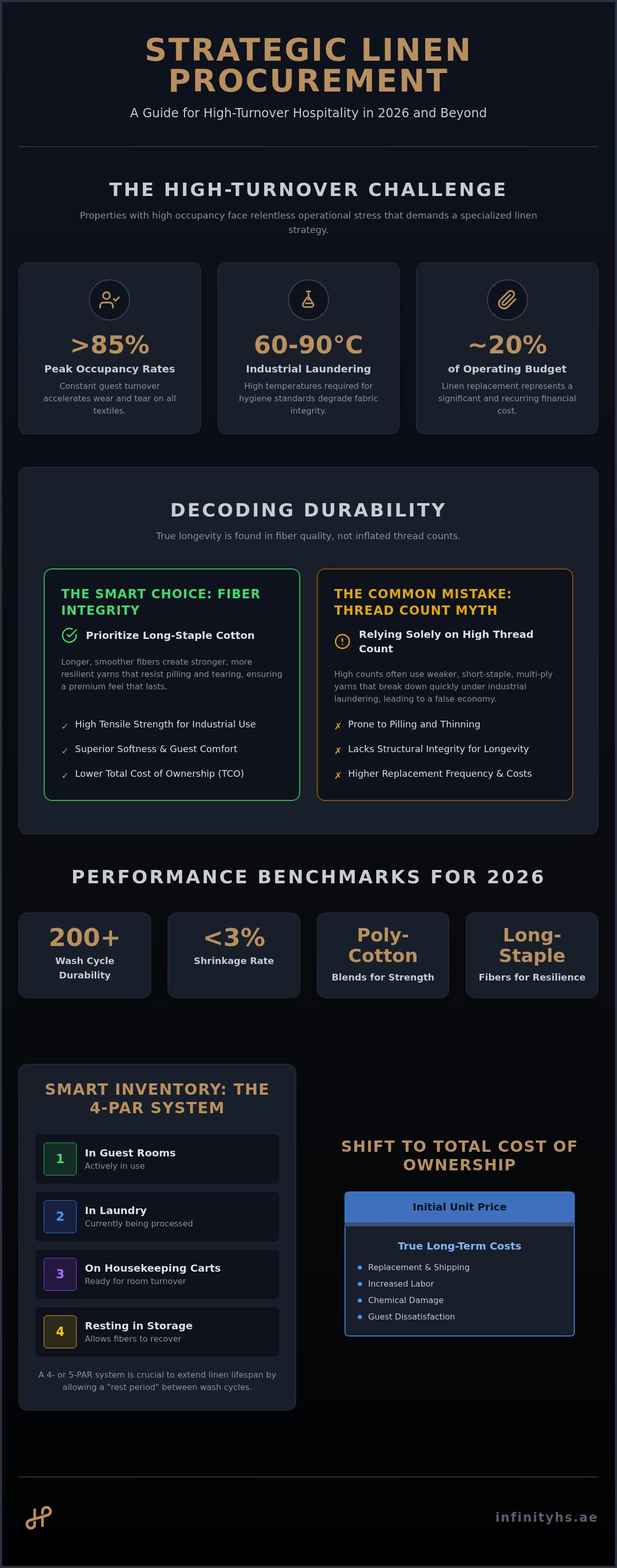
High-turnover properties, particularly those in the GCC with occupancy rates consistently exceeding 85%, subject their operational assets to relentless pressure. In these environments, sourcing durable hotel linens for high-turnover properties is a necessity rather than a luxury. The constant "Wash-Dry-Iron" cycle means a single sheet may be processed hundreds of times a year. Industrial laundering uses temperatures between 60°C and 90°C to meet 2026 hygiene standards, which naturally challenges the structural integrity of even the finest textiles.
To better understand the nuances of textile selection, watch this helpful video:
Beyond the laundry room, the Middle Eastern climate plays a silent role in textile degradation. High ambient humidity and extreme heat can affect how fibers react during the drying process, potentially leading to brittleness if not managed correctly. Understanding Linen fiber properties helps procurement teams identify materials that maintain their tensile strength under these environmental and mechanical stressors. When durability is overlooked, the hidden costs quickly mount. These include increased shipping frequency, additional replacement labor, and the intangible cost of guest dissatisfaction when linens appear grey or feel abrasive.
The Anatomy of Linen Failure
Linen failure usually begins long before a guest notices. It often starts with pilling, where broken fibers tangle on the surface, or thinning, where the fabric loses its "body" and becomes translucent. Automated ironing systems are particularly brutal; they apply significant tension to the fabric. If the tensile strength has been compromised by aggressive bleaching or high-volume chemical exposure, the sheets will simply tear during the ironing phase. Identifying these signs early is vital to maintaining a premium guest experience and preventing a total collapse in fabric integrity.
Linen PAR Levels and Turnover Pressure
Managing high-turnover properties requires a strategic approach to inventory. We recommend a minimum 4-PAR or 5-PAR system to ensure operational stability. This inventory depth allows for a crucial "rest period" for the textiles. When fibers have time to recover their natural shape and moisture balance between wash cycles, their lifespan extends significantly. For a detailed breakdown of inventory management, refer to our Hotel Linen PAR Level Calculation Guide. Without adequate PAR levels, the accelerated turnover forces linens back into the wash too quickly, leading to premature failure and inflated per-stay costs.
Decoding Durability: Technical Specifications for 2026
Durability in 2026 isn't defined by marketing jargon but by measurable technical performance. When sourcing durable hotel linens for high-turnover properties, the focus must shift from perceived luxury to mechanical resilience. Fiber quality remains the primary determinant of success. Long-staple and extra-long staple cotton provide the tensile strength necessary to survive high-pressure ironing. Short-staple fibers, while cheaper, break under tension and lead to premature pilling and thinning. It's these finer details of fiber selection that separate a one-season product from a long-term asset.
The "Thread Count Myth" continues to mislead many procurement teams. In a commercial setting, a 300-thread-count sheet constructed with robust, high-quality yarns often outperforms a 600-thread-count alternative. High thread counts frequently rely on multi-ply, thinner yarns that lack the structural integrity to withstand 200 or more industrial wash cycles. For properties prioritizing longevity, a high-quality poly-cotton blend often provides the "sweet spot." These blends combine the breathability of cotton with the shrink-resistance and tensile strength of polyester, ensuring the fabric remains smooth even after repeated high-heat drying.
Weave Density and Construction
The choice between percale and sateen weaves significantly impacts a product’s lifecycle. Percale, with its tight one-over-one-under structure, is the industry standard for durability. It offers a crisp feel and superior resistance to the mechanical stress of high-speed laundry folding. To prevent pilling, specify "double-singed" yarns. This process removes surface fuzz that typically tangles into pills. Additionally, reinforced hems and high-density selvage construction prevent fraying at the edges, where most fabric failures begin.
Terry Towelling Durability Standards
For towels, weight and yarn type dictate performance. We recommend ring-spun yarns over open-end alternatives for 5-star environments. Ring-spun fibers are smoother and stronger, significantly reducing the risk of fraying and linting. For high-turnover properties, a weight of 550 to 650 GSM (Grams per Square Meter) strikes the ideal balance between guest luxury and drying efficiency. Avoid complex border designs that cause "waisting," where the border shrinks faster than the body of the towel in high-heat dryers. If you're looking to refine your technical specifications, you can discuss your inventory needs with our specialists to ensure your next order meets these rigorous standards.
Strategic Sourcing: Beyond the Unit Price
Procurement teams often fall into the trap of prioritizing the lowest initial unit price. However, in high-turnover hospitality, the real value lies in the Total Cost of Ownership (TCO). A sheet that costs 15% more but survives 200 industrial wash cycles is significantly more cost-effective than a cheaper alternative that fails after 80 washes. When sourcing durable hotel linens for high-turnover properties, you must factor in the frequency of replacement, the cost of global logistics, and the labor required for constant inventory replenishment. True durability is an investment that pays dividends through reduced operational overhead and consistent guest satisfaction.
Rigorous wash-testing is a non-negotiable step in the 2026 procurement process. Before committing to a bulk order, request samples and subject them to at least 20 industrial cycles. This reveals the truth about fabric shrinkage, which should remain below 3% to meet international commercial standards. These tests also expose issues with colorfastness and pilling that aren't visible in a showroom. In 2026, sustainability has also become a core procurement pillar. Sourcing organic or recycled linens, backed by certifications like the Global Recycled Standard (GRS) or OEKO-TEX STANDARD 100, allows properties to meet eco-conscious goals without sacrificing the tensile strength required for daily flips.
Quality Control in Global Sourcing
Managing quality across a global supply chain requires a physical presence at the source. On-site inspections in manufacturing hubs like China and the UK ensure that the technical specifications you've set are met before the goods ever reach a container. Standardizing these specifications across your entire property portfolio prevents the inconsistent quality often seen when using fragmented regional suppliers. For operators in the Middle East, Sourcing Premium Hotel Linen in the UAE through a partner with global oversight ensures that every shipment meets the exact same durability benchmarks, regardless of the manufacturing origin.
Supply Chain Resilience for High-Occupancy
High-occupancy environments leave little room for supply chain delays. Managing lead times for high-volume replenishment requires a mix of strategic forecasting and local support. Local warehousing in Dubai offers a significant advantage for GCC properties, providing a rapid-response capability that international shipping cannot match. Given the market disruptions seen in early 2026, diversifying your sourcing across different geographical regions is essential. This strategy mitigates the risks of logistics bottlenecks and ensures your property always has the 4-PAR or 5-PAR inventory levels needed to maintain operational excellence.
Operational Excellence: Maximizing the Lifecycle of Your Linens
Operational excellence begins the moment your order arrives at the loading dock. While sourcing durable hotel linens for high-turnover properties is the foundational step, their actual lifespan is determined by daily handling and maintenance routines. Standard Operating Procedures (SOPs) must prioritize the "First-In, First-Out" (FIFO) rotation method. Professional hospitality organizations, such as U Hotel Group, often implement these rigorous standards to maintain textile integrity across their diverse hotel portfolios. This ensures that every piece in your 4-PAR or 5-PAR system receives equal usage and adequate rest. Without a strict rotation policy, a subset of your inventory faces accelerated degradation, leading to inconsistent quality across guest rooms and premature replacement costs.
The physical journey of a sheet from the laundry to the bed is fraught with mechanical risks. Dragging linen bags across floors or over-stuffing storage areas causes micro-tears that compromise tensile strength over time. Utilizing specialized housekeeping trolleys is essential for preserving fabric quality during transit. These units prevent environmental contamination and reduce the physical strain on the fabric. Staff training should focus on early identification; your housekeeping teams are the first line of defense. They must be empowered to reject linens showing early signs of pilling or thinning before they ever reach a guest's sight.
Industrial Laundry Partnership
The chemistry of the wash cycle is the most significant factor in textile longevity. Aggressive chlorine bleaching might achieve temporary whiteness, but it destroys cotton fibers at a molecular level. Partnering with laundry providers who prioritize chemical titration accuracy and pH balancing is vital. In the GCC, water hardness remains a persistent challenge. High mineral content often leads to "greying" or "yellowing" as minerals trap soil within the fibers. Managing this requires specific sequestering agents in the wash formula to maintain a crisp finish and prevent the fabric from becoming abrasive.
Temperature control is equally critical for balancing hygiene with fabric health. While 2026 hygiene standards require high temperatures for disinfection, maintaining a consistent 60°C benchmark ensures safety without the excessive fiber stress caused by boiling cycles. This balance protects the double-singed yarns and reinforced hems that define high-performance textiles. By auditing your laundry partner’s processes for temperature and chemical consistency, you ensure that the technical specifications you invested in during procurement aren't neutralized by poor operational habits.
The Infinity Advantage: Turnkey Linen Solutions for the GCC
Managing the complexities of a high-occupancy property requires more than just a vendor; it demands a strategic partner with global reach and local precision. Infinity Hotel Supplies provides a turnkey model that simplifies the process of sourcing durable hotel linens for high-turnover properties by managing the entire lifecycle from manufacturing to final delivery. Our physical presence in the UAE, China, and the UK allows us to maintain a meticulous quality control process at the manufacturing source while ensuring rapid logistics for our clients in the GCC. This global operational footprint means we don't just ship products. We provide a stable, end-to-end supply chain that protects your operational budget. Our turnkey model ensures that sourcing durable hotel linens for high-turnover properties is a data-driven process rather than a guessing game.
Whether you're operating a boutique heritage site or a 1,000-room mega-resort, our team crafts bespoke specifications that align with your brand's luxury standards and durability requirements. We understand that a 5-star property in Riyadh faces different mechanical stress factors than a business hotel in Dubai. By tailoring thread counts, yarn types, and GSM levels to your specific laundry facilities and occupancy patterns, we ensure your investment remains resilient over hundreds of cycles. This personalized approach allows us to scale your linen program efficiently, maintaining consistency across your entire portfolio even during periods of rapid expansion.
One-Stop Procurement for OS&E
A cohesive guest experience depends on the seamless integration of all room elements. Our turnkey approach allows you to bundle your linen requirements with other essential OS&E, such as premium bathroom accessories and room supplies. This holistic methodology is particularly valuable during pre-opening and renovation phases, where consistency across multiple categories is critical for a successful launch. We provide strategic guidance to ensure your textile choices complement your broader OS&E strategy. For a deeper look at how we manage these complex projects, explore our guide on Hospitality Procurement Solutions for 2026.
Global Expertise, Local Support
With over 10 years of experience in the GCC market, we've developed a pragmatic understanding of the unique challenges facing regional operators. Our personality as a comprehensive provider means we handle the logistical heavy lifting, allowing your management teams to focus on guest satisfaction. We've navigated the specific environmental stressors and supply chain nuances of the Middle East since 2014, making us a seasoned ally in a volatile market. It's this blend of global expertise and local responsiveness that defines our commitment to your success. If you're ready to stabilize your textile costs and improve guest scores, contact our Dubai office today for a comprehensive linen audit.
Elevating Your Operational Standards for 2026
Mastering the balance between guest luxury and industrial durability requires a shift in procurement strategy. The key to success lies in prioritizing technical specifications like staple length and weave density over marketing myths. By focusing on the total cost of ownership and implementing rigorous maintenance SOPs, you can significantly extend the lifecycle of your textiles. Sourcing durable hotel linens for high-turnover properties is a critical component of your property's long-term financial health and guest satisfaction.
Infinity Hotel Supplies brings over a decade of experience to the GCC market, providing the meticulous quality control and global reach needed for high-end hospitality. With offices in the UAE, China, and the UK, we offer turnkey solutions that ensure your properties maintain excellence through every wash cycle. We're dedicated to being your steady partner in navigating the complexities of modern procurement and supply chain management.
Your property deserves the security of high-performance linens that stand the test of time. Let's build a more resilient and sophisticated supply chain together.
Frequently Asked Questions
What is the best thread count for durable hotel sheets in high-turnover properties?
The optimal thread count for durable hotel sheets in high-turnover properties typically ranges between 250 and 300. While higher thread counts often suggest luxury, they frequently rely on thinner, multi-ply yarns that lack the tensile strength required for industrial laundering. A well-constructed 300-thread-count percale weave provides the crisp feel guests expect while maintaining the structural integrity to survive over 200 wash cycles without thinning or pilling.
How many PARs of linen should a high-occupancy hotel maintain?
High-occupancy hotels should maintain a minimum of 4-PAR or 5-PAR to ensure operational stability. This inventory depth allows one set to be in the room, one in the laundry, one in storage, and one resting. Rest periods are essential for fiber recovery; without them, linens face constant mechanical stress and fail prematurely. In the GCC, where occupancy often exceeds 85%, a 5-PAR system is the safest benchmark for long-term textile health.
Why do hotel linens turn grey or yellow in Middle Eastern laundries?
Linens in the Middle East often turn grey or yellow due to high mineral content in the water and improper chemical titration. Hard water traps soil and detergent residue within the cotton fibers, leading to a dull appearance. To prevent this, laundries must use specific sequestering agents and maintain precise pH levels. Regular audits of your laundry partner's chemical formulas are necessary to ensure that mineral deposits don't compromise your linen's aesthetic quality.
Is 100% cotton better than a poly-cotton blend for durability?
Poly-cotton blends are generally superior when sourcing durable hotel linens for high-turnover properties. While 100% cotton offers a premium feel, it's prone to significant shrinkage and faster fiber degradation in industrial dryers. A 70/30 or 80/20 cotton-polyester blend provides a "sweet spot," combining the breathability of cotton with the tensile strength and wrinkle resistance of polyester. These blends typically experience less than 3% shrinkage and require less energy for drying.
How can I test the durability of a linen sample before buying in bulk?
You should subject any linen sample to at least 20 consecutive industrial wash cycles at 60°C to 90°C before committing to a bulk order. After these cycles, measure the fabric for shrinkage, which should not exceed 3% to meet 2026 commercial standards. Inspect the surface for pilling and check the hems for fraying. This "wash-test" reveals how the fibers react to real-world mechanical stress, ensuring you don't invest in products that fail after a few months.
What is the average lifespan of a high-quality hotel bed sheet?
A high-quality hotel bed sheet should last between 150 and 250 industrial wash cycles, depending on the laundry chemistry and PAR levels. Sheets that are rested properly between uses last significantly longer than those in a 2-PAR system. In high-turnover GCC properties, the lifespan is often measured in months rather than years. Regular monitoring of tensile strength and surface texture helps procurement teams forecast replacement needs before guest satisfaction scores begin to drop.
How does GSM affect the durability of hotel towels?
GSM, or Grams per Square Meter, dictates the weight and absorbency of a towel. For 5-star properties, a weight of 550 to 650 GSM is the ideal durability benchmark. While heavier towels feel more luxurious, they require longer drying times at higher temperatures, which can make the fibers brittle. Conversely, towels below 500 GSM often lack the structural density to resist fraying and "waisting" during the high-heat drying cycles common in high-volume laundry facilities.
Can sustainable or organic linens be durable enough for high-turnover use?
Sustainable linens are absolutely durable enough for high-turnover use if they meet specific industrial construction standards. Organic cotton must use long-staple fibers to match the tensile strength of conventional textiles. Look for certifications like the Global Recycled Standard (GRS) or OEKO-TEX STANDARD 100 to ensure the fabric is free from harmful chemicals that can weaken fibers. When sourced correctly, these eco-friendly options provide the same 200-cycle lifespan as their traditional counterparts.

Article by
Infinity Editorial Team
With deep expertise in hospitality product FF&E and OS&E across the Middle East and Africa, Infinity Editorial Team brings insights from Infinity Hotel Supplies, helping developers, hoteliers, and homeowners transform spaces from empty shells to fully furnished, design-ready environments.
Disclaimer
The content published by Infinity Editorial Team is intended for informational purposes only. All articles, guides, and insights are based on industry knowledge and experience in hospitality FF&E and OS&E supply across the Middle East and Africa. Infinity Hotel Supplies does not guarantee specific outcomes and recommends consulting a qualified professional for project-specific requirements.


